
Isometric diagram of a teal dinucleotide cofactor accepting a single amber electron particle with a circular arrow, representing the NAD+ to NADH redox cycle
Mindful Research

NAD+ as a Redox Cofactor: A Research Profile (In Vitro)

Updated By: Mindful Research Team1 min read

Key takeaways

  • NAD+ is a redox cofactor studied in vitro for electron-transfer reactions.
  • It cycles between its oxidized form (NAD+) and reduced form (NADH).
  • The NAD+/NADH ratio is a common in-vitro readout.
  • Measured with biochemical assays in cell lysates or defined reaction systems.
  • Supplied as a research material for in vitro research use only.

Referenced in this article

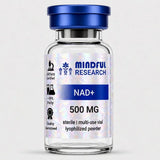
NAD+ NAD+$60.00 Shop now

NAD+ is a redox cofactor studied in vitro for its role in electron-transfer reactions, cycling between its oxidized form (NAD+) and reduced form (NADH). This profile describes the cofactor and its study.

What is NAD+?

NAD+ (nicotinamide adenine dinucleotide) is a cofactor that participates in electron-transfer reactions across many enzymes. It is described here only by structure and biochemical role, as a research material.

The NAD+/NADH cycle

NAD+ accepts electrons to become NADH, and NADH gives up electrons to return to NAD+. This cycle is central to redox chemistry, and the NAD+/NADH ratio is a common in-vitro readout.

How it is studied in vitro

Researchers measure NAD+ and NADH levels, or the ratio between them, with biochemical assays in cell lysates or defined reaction systems, under controlled conditions.

Why the cofactor is of research interest

As a central redox cofactor, NAD+ is a tool for probing cellular energy and redox pathways in a reproducible laboratory system.

Related research guides

Research-use note

NAD+ is supplied as a research material for in vitro research use only. It is not for human or animal use.

Related research: LIPO-C | MIC-C.
Frequently asked questions

What is NAD+?

Nicotinamide adenine dinucleotide, a cofactor in electron-transfer reactions, studied in vitro as a research material. View NAD+

What is the NAD+/NADH cycle?

NAD+ accepts electrons to become NADH, and NADH returns to NAD+; this cycle is central to redox chemistry.

How is it studied in vitro?

By measuring NAD+ and NADH levels or their ratio with biochemical assays in cell lysates or defined reaction systems.

Why is it of research interest?

As a central redox cofactor, it is a tool for probing cellular energy and redox pathways.

Research use only?

Yes, in vitro laboratory research use only.

More research materials