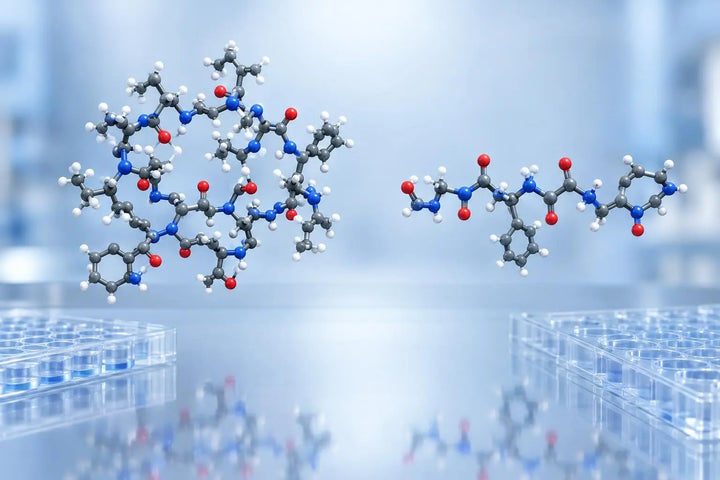
There is no established peptide hormone or receptor called GLP-3. Glucagon-like peptide-1 (GLP-1) and glucagon-like peptide-2 (GLP-2) are real hormones cleaved from proglucagon, each with its own receptor; "GLP-3" is a supplier catalog label that, in practice, almost always refers to retatrutide, the compound sold as GLP-3 RT or RT-GLP3.
Searches such as "glucagon like peptide 3", "GLP3", "what is GLP-3" and "GLP-3R" all run into the same confusion: the word sounds like a third member of a hormone family, so people assume a receptor class exists. This guide separates the real glucagon-family peptides from the label, in laboratory and nomenclature terms only.
What are the real glucagon-like peptides?
Proglucagon is a single precursor protein. Tissue-specific enzymes cut it into different products: in pancreatic alpha cells mainly glucagon, and in intestinal L cells mainly GLP-1, GLP-2, oxyntomodulin and glicentin. Of these, GLP-1 and GLP-2 are the two "glucagon-like peptides" that are recognized as hormones in their own right.
| Peptide | Length | Receptor | Origin |
|---|---|---|---|
| Glucagon | 29 residues | GCGR | Proglucagon, pancreatic alpha cells |
| GLP-1 (7-36 amide) | 30 residues | GLP-1R | Proglucagon, intestinal L cells |
| GLP-2 (1-33) | 33 residues | GLP-2R | Proglucagon, intestinal L cells |
| Oxyntomodulin | 37 residues | GLP-1R and GCGR | Proglucagon, intestinal L cells |
| GIP (1-42) | 42 residues | GIPR | Separate precursor (proGIP), K cells; not proglucagon-derived |
The receptors involved (GLP-1R, GLP-2R, GIPR and GCGR) all belong to the class B1 family of G-protein-coupled receptors. No "GLP-3 receptor" appears in that family. For the GLP-1 branch in depth, see the store's guide to GLP-1 peptides and receptor signaling in vitro.
So what is "GLP-3"?
"GLP-3" is a catalog numbering convention. Some supplier catalogs number three well-known engineered incretin-type peptides as GLP-1, GLP-2 and GLP-3 by product tier. On this site the product codes SM-GLP1, T-GLP2 and RT-GLP3 follow that convention. The code is only a label; the CAS number and the analytical report define the molecule. The "GLP-3" slot is occupied by retatrutide (CAS 2381089-83-2), which is why searches for "GLP-3 RT" and "RT-GLP3" describe the same material, covered in GLP-3 RT (RT-GLP3) Explained.
The numbering also shows why labels mislead. The catalog code "T-GLP2" does not refer to the intestinal GLP-2 hormone. Its listed specification (CAS 2023788-19-2) is tirzepatide, a dual GIP/GLP-1 agonist. A label in the style of "GLP-2" or "GLP-3" therefore tells you about the catalog, not about the receptor biology.
What about "GLP-3R" and "GLP3R"?
Read as "GLP-3 receptor", the term names nothing: the defined receptors are GLP-1R and GLP-2R. In supplier shorthand the trailing R usually stands for retatrutide, giving the same compound as "GLP-3 RT". Because both readings circulate, a lab should never infer the receptor target from the label alone.
How the labels compare
| Label | What it is | Receptor(s) in vitro | Natural hormone? |
|---|---|---|---|
| GLP-1 | Native 30-residue hormone | GLP-1R | Yes |
| GLP-2 | Native 33-residue hormone | GLP-2R | Yes |
| GIP | Native 42-residue incretin | GIPR | Yes |
| "GLP-3" (catalog label) | Retatrutide, an engineered 39-residue peptide | GLP-1R, GIPR, GCGR | No |
How do you check what a "GLP-3" product actually is?
Ignore the numbering and read the evidence: CAS number, molecular formula, and a batch report showing HPLC purity and a mass-spectrometry identity result. For this material the free-peptide mass is about 4731 Da. If you want the retatrutide-specific answer to the naming question, it is in Is Retatrutide a GLP-3?
Related research guides
Research-use note
All materials discussed are supplied for in vitro laboratory research use only, and are not for human or animal use.