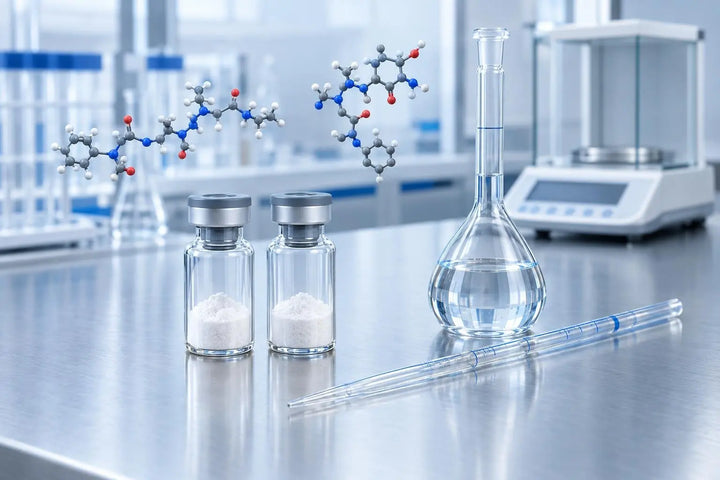
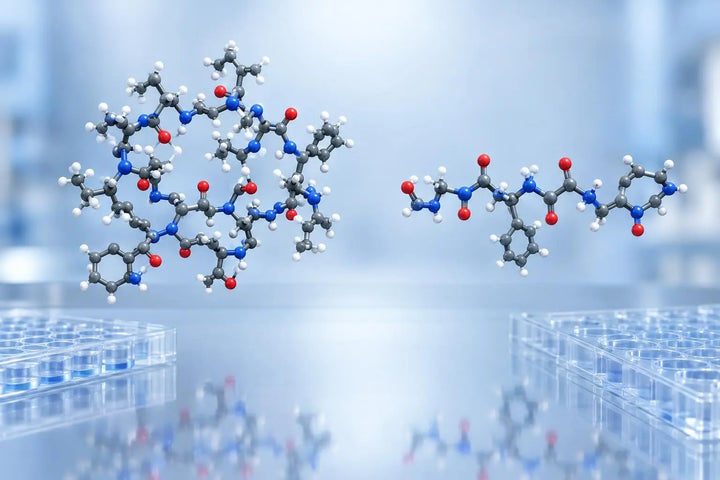
A credible BPC-157, TB-500 blend COA must confirm both peptides independently—each resolved by mass spectrometry at its expected mass and each quantified by HPLC—so that identity, per-component purity and the stated ratio are all documented, not assumed.
Sourcing a two-component research material adds a verification step over a single peptide: you are confirming two identities in one vial. This guide covers what to look for on a BPC-157, TB-500 certificate of analysis. For research use only.
What should a blend COA show?
- Two identities by mass. Mass spectrometry should show peaks consistent with BPC-157 (~1419.5 g/mol) and TB-500 (~4963 g/mol) as separate species. The large mass gap makes the two easy to distinguish—see mass spectrometry for peptide identity.
- Per-component purity by HPLC. A blend complicates a single purity number, so the report should make clear how each peptide’s purity was assessed; how purity is measured by HPLC explains the chromatogram.
- Content / ratio. The stated masses (e.g. 10 mg / 10 mg) should be supported by a content measurement, confirming the 1:1 ratio rather than inferring it.
- Endotoxin and net content as for any research peptide.
How do you read it line by line?
Work top to bottom: identity first (both masses present), then purity (per component), then content/ratio, then endotoxin. The general walkthrough in reading a COA line by line applies; the only blend-specific difference is that every identity and purity line should appear twice—once per peptide. A COA that reports a single peak or a single purity figure has not actually verified a blend.
How does this differ from a single-peptide COA?
For a single compound you confirm one mass and one purity value. For the blend you confirm two of each and the ratio between them. The underlying methods are identical; there is just more to check. The single-compound sourcing logic is covered in the BPC-157 structure profile and TB-500 profile.
Related research guides
- BPC-157, TB-500 blend profile
- Mass spectrometry for peptide identity
- Reading a COA line by line
- HPLC: how purity is measured
Research-use note
All materials discussed are supplied for in vitro laboratory research use only, and are not for human or animal use.