TB-500 is the synthetic, N-acetylated form of thymosin beta-4 (Tβ4), a single-chain 43-residue peptide (CAS 77591-33-4, C212H350N56O78S, MW ~4963), studied in vitro as an actin-sequestering peptide — not the short Ac-LKKTETQ fragment it is often confused with.
Search the term "tb 500 peptide" and you will find two different molecules described as if they were one: the full-length thymosin beta-4 polypeptide, and a seven-residue fragment of it. For anyone sourcing or characterising a research material, that distinction decides what the certificate of analysis should show. This profile sets out what the compound actually is, in vitro-framed and identity-first.
What is TB-500?
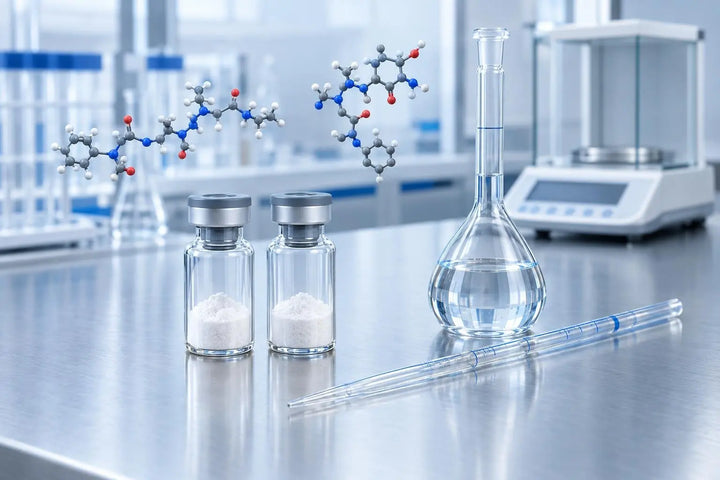
TB-500 is supplied by Happy Peptides as TB-500 as a white lyophilized powder and corresponds to the full 43-amino-acid sequence of thymosin beta-4 with an acetylated N-terminus. Its catalog identity is fixed by CAS 77591-33-4, molecular formula C212H350N56O78S and a monoisotopic-scale molecular weight near 4963 g/mol. The international nonproprietary name (INN) for this peptide is timbetasin; "TB-500" and "Tβ4" are the names more common in research catalogs.
Is TB-500 a fragment or the full protein?
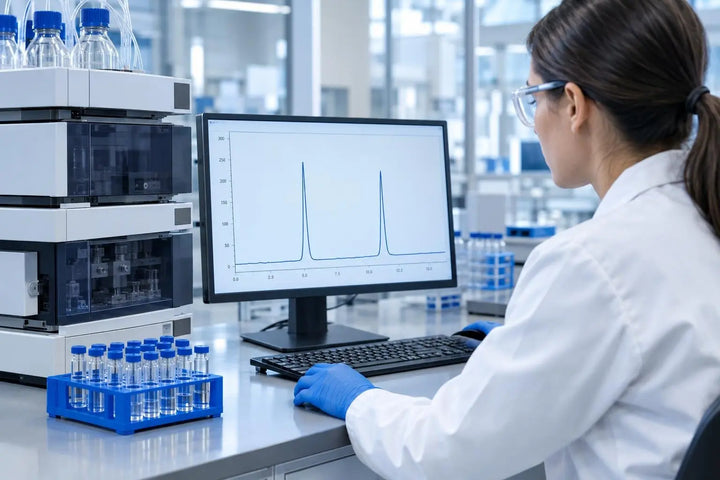
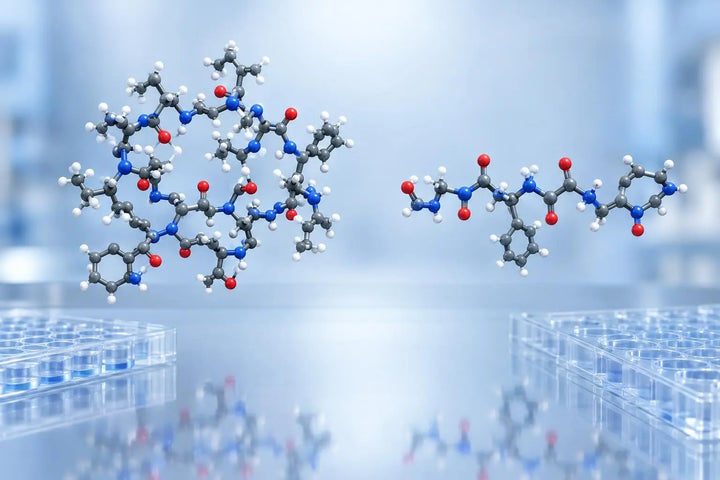
Both descriptions circulate because thymosin beta-4 contains a conserved actin-binding motif, the Ac-LKKTETQ sequence, within residues 17–23. Some suppliers market that short heptapeptide as "TB-500," while others — including this catalog — supply the complete 43-mer. They are not interchangeable: they differ in mass by roughly an order of magnitude, elute differently on HPLC, and give entirely different mass-spectrometry signatures. The only reliable way to know which molecule a vial contains is to read its analytical data.
| Attribute | Full-length Tβ4 (TB-500) | Ac-LKKTETQ fragment |
|---|---|---|
| Residues | 43 | 7 |
| Approx. MW | ~4963 g/mol | ~889 g/mol |
| Catalog identity | CAS 77591-33-4 | n/a (fragment) |
What in-vitro models is thymosin beta-4 used in?
Thymosin beta-4 is best characterised in the laboratory as a G-actin sequestering peptide: it binds monomeric actin and participates in cytoskeletal dynamics. That biochemistry is studied with scratch and cell-migration assays and with angiogenesis-pathway readouts in cultured cells. These are mechanism and assay-design contexts only; this page makes no claim about outcomes in a living organism.
How does TB-500 compare with BPC-157?
TB-500 and BPC-157 are frequently sourced together because both are studied in tissue-repair research models, but they are structurally unrelated — BPC-157 is a 15-residue pentadecapeptide, see the BPC-157 structural profile. Laboratories comparing them often also work with the two-component BPC-157, TB-500 blend and the single BPC-157 profile.
How is TB-500 handled in the lab?
As a lyophilized powder it is reconstituted for in-vitro work with a suitable solvent such as bacteriostatic water, then aliquoted. Stock concentration is expressed in mg/mL or molarity — worked through in the vial concentration-math guide — and solution behaviour is covered in the stability-in-solution notes.
Related research guides
- TB-500 structure: the Ac-LKKTETQ motif
- TB-500 stability in solution
- TB-500 vial stock concentration math
- Sourcing TB-500: COA and purity
- Thymosin alpha-1 vs beta-4 compared
Research-use note
All materials discussed are supplied for in vitro laboratory research use only, and are not for human or animal use.