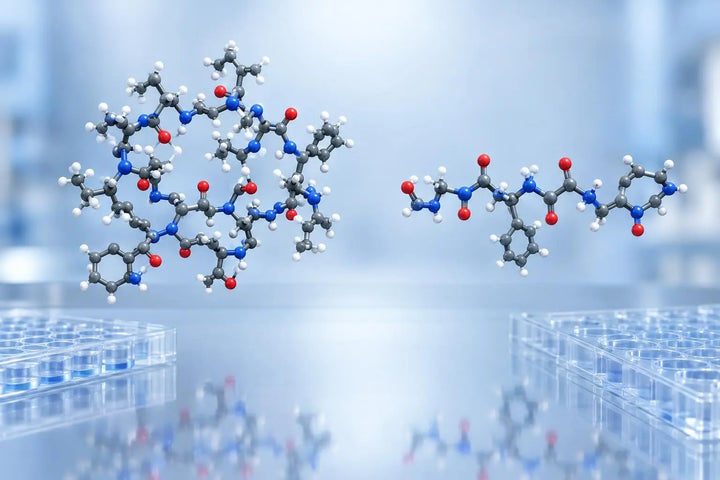
The Ac-LKKTETQ sequence is a seven-residue actin-binding motif found within thymosin beta-4; TB-500 as supplied is the complete 43-residue peptide that contains this motif, not the isolated heptapeptide.
Where does the Ac-LKKTETQ motif sit in the sequence?
Full-length thymosin beta-4 has the acetylated sequence Ac-Ser-Asp-Lys-Pro-Asp-Met-Ala-Glu-Ile-Glu-Lys-Phe-Asp-Lys-Ser-Lys-Leu-Lys-Lys-Thr-Glu-Thr-Gln-… (43 residues total). The Leu-Lys-Lys-Thr-Glu-Thr-Gln stretch near residues 17–23 is the conserved actin-binding region, which is why the shorthand "LKKTETQ" appears so often in the literature. In the TB-500 research material this motif is one segment of the intact chain.
Why does the motif matter for identity?
Because the motif is only part of the molecule, a vial labelled "TB-500" should still resolve as a ~4963 g/mol species, not as the ~889 g/mol heptapeptide. Confirming that is a mass-spectrometry question — see how purity and identity are measured. The distinction is the core of the TB-500 vs thymosin beta-4 profile.
How is the structure studied in vitro?
The actin-sequestering behaviour of the intact peptide is examined with scratch and cell-migration assays and cytoskeletal readouts. These describe molecular behaviour in culture, not any outcome in an organism.
Related research guides
Research-use note
All materials discussed are supplied for in vitro laboratory research use only, and are not for human or animal use.