HPLC measures peptide purity by separating a sample into its components and reporting what percentage of the material is the target peptide. This guide explains how that works.
What is HPLC?
High-performance liquid chromatography pushes a dissolved sample through a column under high pressure. Different molecules travel through at different rates, so they separate and emerge at different times.
How separation becomes a purity number
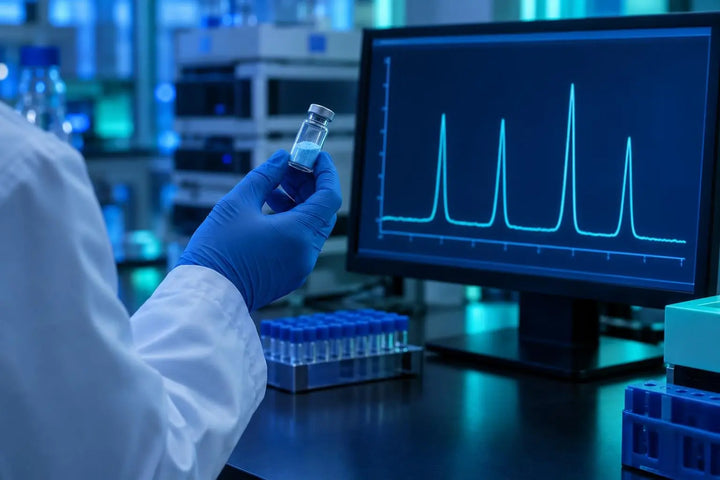
As each separated component leaves the column, a detector records it as a peak. The area under the target peptide's peak, divided by the total area of all peaks, gives the purity percentage.
Reading an HPLC trace
A clean trace shows one dominant peak for the target peptide and small or negligible peaks for impurities. Several large peaks indicate lower purity or multiple species.
Why HPLC pairs with mass spectrometry
HPLC tells you how much of the sample is the main component but not definitively what it is. Mass spectrometry confirms the identity, so the two methods are reported together on a COA.
Find a COA: search every third-party lab report by product or batch number in our certificate of analysis library.
Related research guides
Research-use note
All materials discussed are supplied for in vitro laboratory research use only.