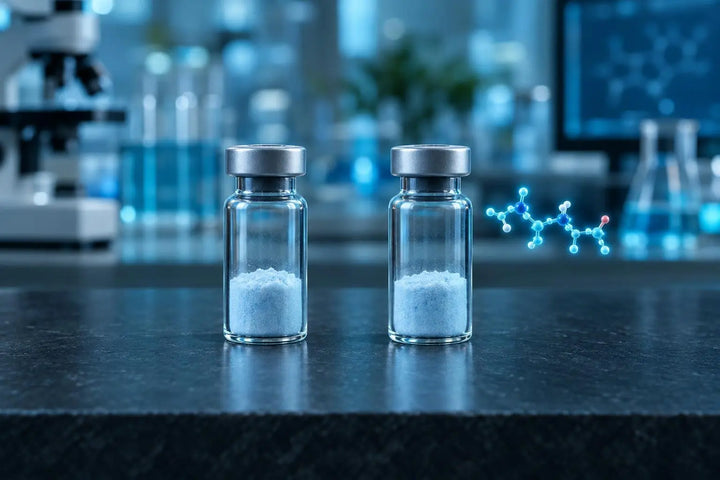
The KLOW 80 mg vial is a pale-blue lyophilized powder because one of its four components, GHK-Cu, is a copper(II) complex; reconstituted in 1 mL it gives 10 mg/mL BPC-157 (about 7.0 mM), 10 mg/mL TB-500 (about 2.0 mM), 50 mg/mL GHK-Cu (about 124 mM) and 10 mg/mL KPV (about 29 mM), with every figure halving in 2 mL and quartering in 4 mL. This guide covers why the powder looks the way it does, how to store and handle it, and the per-component concentration math for the 80 mg vial.
Why is the lyophilized powder blue?
Three of the four peptides in KLOW, BPC-157, TB-500 and KPV, are white solids. The fourth, GHK-Cu, is the tripeptide Gly-His-Lys coordinated to a copper(II) ion through the imidazole nitrogen of histidine and the N-terminal amine, and that coordination complex absorbs in the red, so it appears blue. At 50 mg per vial the copper complex is the largest component by mass, and its colour dominates the whole powder and the reconstituted solution. The chemistry is set out in GHK-Cu copper coordination chemistry. A colourless KLOW vial would mean the copper complex is missing and is a reason to check the certificate before use.
How should the lyophilized vial be stored?
Cold, dark and dry, as for any lyophilized peptide. The copper complex is stable as a dry solid; the general practice in cold-chain storage for research peptides and light and moisture protection applies. Let the vial reach room temperature before opening so that moisture does not condense on the powder.
How is the vial reconstituted?
Add reconstitution solution down the inside wall, then swirl. Because the solution is blue, it is easy to see when the powder has fully dissolved: the liquid should be uniformly coloured with no particles. Do not shake; TB-500, the largest component, is a 43-residue polypeptide and foaming is best avoided. With 80 mg of solids, 2 mL or more is the more comfortable volume; 1 mL gives a dense solution.
What is the stock concentration at 1, 2 and 4 mL?
| Volume | BPC-157 (1419.5) | TB-500 (4963) | GHK-Cu (402.92) | KPV (342.43) |
|---|---|---|---|---|
| 1 mL | 10 mg/mL, 7.04 mM | 10 mg/mL, 2.01 mM | 50 mg/mL, 124 mM | 10 mg/mL, 29.2 mM |
| 2 mL | 5 mg/mL, 3.52 mM | 5 mg/mL, 1.01 mM | 25 mg/mL, 62.0 mM | 5 mg/mL, 14.6 mM |
| 4 mL | 2.5 mg/mL, 1.76 mM | 2.5 mg/mL, 0.50 mM | 12.5 mg/mL, 31.0 mM | 2.5 mg/mL, 7.30 mM |
Worked example for KPV in 2 mL: 10 mg ÷ 342.43 g/mol = 29.2 µmol; 29.2 µmol ÷ 2 mL = 14.6 mM. The same two steps, mass over molecular weight over volume, give every cell, as in the reconstitution math guide. This is the calculation a query such as "KLOW 80 mg reconstitution calculator" is asking for; because the blend has four molecular weights, the answer is always four numbers.
How are working solutions and stability handled?
Aliquot the stock immediately so that each aliquot is thawed once; repeated freeze-thaw cycles are the main avoidable source of loss, as discussed in aliquoting and freeze-thaw. Store aliquots frozen and make working dilutions fresh in assay medium on the day of the experiment. A 1 : 1000 dilution of the 2 mL stock gives 3.5 µM BPC-157, 1.0 µM TB-500, 62 µM GHK-Cu and 14.6 µM KPV. Keep a vehicle control and a copper-only control (copper chloride at 62 µM in this example) alongside, so that metal-ion effects can be separated from peptide effects.
How is a KLOW concentration reported?
As four molarities, with the lot number and the reconstitution volume. Reporting the stock as "80 mg/mL" hides a sixty-fold molar difference between TB-500 and GHK-Cu. The conventions are collected in multi-peptide research blend terminology, and the composition itself is described in the KLOW blend profile.
Related research guides
- KLOW peptide blend: components and in-vitro research profile
- What is KLOW peptide? Component-by-component breakdown
- GLOW 70 mg vial: specification and stock concentration math
- GHK-Cu and copper coordination chemistry in vitro
- Aliquoting and freeze-thaw practice for research peptides
Research-use note
All materials discussed are supplied for in vitro laboratory research use only, and are not for human or animal use.