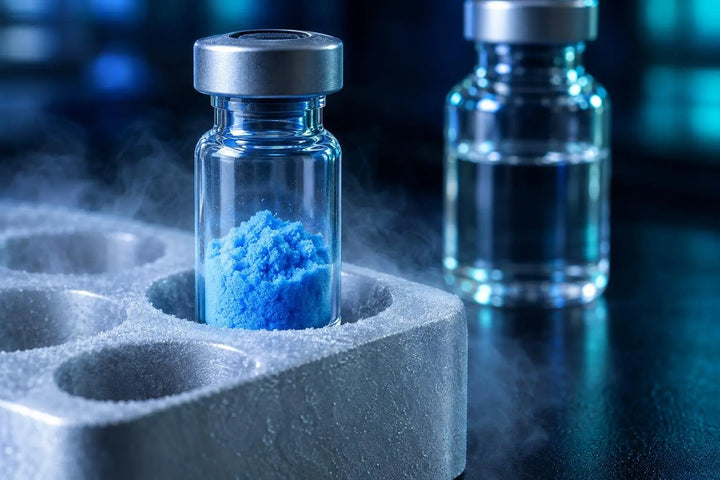
A multi-peptide research blend is a defined co-formulation of two or more named synthetic peptides, each at a listed mass, combined and lyophilized in a single vial; it is described by its components and their CAS numbers, reported by the molarity of each component, and certified by one identity and one purity value per peptide. This guide sets out the vocabulary and the conventions, using the catalog's blends GLOW and KLOW as the worked examples.
What counts as a research blend?
Three things have to be true. The components are named peptides with their own identifiers; the mass of each per vial is listed; and the components are physically combined before lyophilization, so that one vial yields one solution with a fixed ratio. GLOW (BPC-157, TB-500 and GHK-Cu, 70 mg) and KLOW (the same three plus KPV, 80 mg) meet all three. The older two-component BPC-157/TB-500 blend is the same idea with two peptides.
What a blend is not: it is not a new molecule, it has no sequence or CAS number of its own, and the catalog name is a label for the composition rather than a chemical descriptor.
Why "blend" and "co-formulated" rather than other words?
Vendor pages and forums sometimes describe multi-peptide vials with a word borrowed from bodybuilding slang. That word carries an implication of combining products for an effect in a person, which is outside the in vitro frame in which these materials are supplied, and it also fails as a description: it says nothing about which peptides, at what masses, in what ratio. "Blend" and "co-formulation" are the terms used in formulation chemistry for exactly this kind of defined mixture, and they are the terms used throughout this catalog and these guides.
How is composition described: by mass or by molarity?
Both, but for different purposes. Mass composition (10 mg + 10 mg + 50 mg for GLOW) is what the vial label and the COA state, and it is what the laboratory weighs out, in effect, when it reconstitutes the vial. Molar composition is what the cells in an assay experience, and it can look nothing like the mass ratio when the components' molecular weights differ a lot. GLOW is 1 : 1 : 5 by mass but roughly 3.5 : 1 : 62 by molarity, because GHK-Cu (402.92 g/mol) is so much lighter than TB-500 (4963 g/mol). The arithmetic is in the GLOW 70 mg concentration-math guide.
| Convention | Use it for | Example (GLOW in 2 mL) |
|---|---|---|
| Mass per vial | Label, COA, ordering | 10 mg BPC-157, 10 mg TB-500, 50 mg GHK-Cu |
| Mass concentration | Stock preparation | 5, 5 and 25 mg/mL |
| Molar concentration | Assay design and reporting | 3.5 mM, 1.0 mM and 62 mM |
How should a blend be written in a methods section?
By component. A reproducible description names each peptide with its CAS number, gives the mass per vial from the lot COA, states the reconstitution volume, and gives the final molarity of each component in the assay. "GLOW, 10 µg/mL" is not reproducible; "BPC-157 (CAS 137525-51-0) 3.5 µM, TB-500 (CAS 77591-33-4) 1.0 µM, GHK-Cu (CAS 89030-95-5) 62 µM, from a co-formulated vial, lot X" is. Where a blend is compared with single peptides, the single-peptide arms are run at the same molarity as that component in the blend.
How is a blend certified?
One identity and one purity value per component. The COA for a three-peptide blend should carry three HPLC purities and three mass-spectrometry identities, so that the reader can confirm each peptide is present at the expected mass. A single number for the vial cannot show that. The specific checks are in verifying a multi-component blend COA; the general reading guide is reading a COA line by line.
Naming conventions in this catalog
Catalog blend names (GLOW, KLOW) are short labels. Each product page lists the components, their masses, CAS numbers, formulas and molecular weights, and the guides for each blend start by expanding the label into its composition: see what is GLOW peptide and what is KLOW peptide. When a query uses a variant such as "GLOW blend" or "GLOW blend peptide", it refers to the same composition.
Related research guides
- GLOW peptide blend: components and in-vitro dermal research profile
- KLOW peptide blend: components and in-vitro research profile
- GLOW vs KLOW: what KPV adds to the blend
- Verifying a multi-component blend COA
- Reading a peptide spec sheet: CAS, MW, formula and purity
Research-use note
All materials discussed are supplied for in vitro laboratory research use only, and are not for human or animal use.