A Certificate of Analysis for a multi-peptide blend such as GLOW or KLOW is verified component by component: it must show an HPLC purity and a mass-spectrometry identity for each named peptide, with observed masses that match the expected molecular weights, and it must state the component ratio for the lot. This guide lists the checks, explains why a single purity figure is not enough, and notes what the cost of a blend as a research material reflects.
Why is a blend COA different from a single-peptide COA?
A single-peptide certificate answers two questions: is this the right molecule, and how pure is it. A blend has to answer those questions for every component and add a third: are they present in the stated ratio. For GLOW that is three identities, three purities and one ratio; for KLOW it is four of each. A certificate that reports one HPLC percentage for the vial has skipped the identity question entirely, because a chromatogram with several peaks cannot by itself say which peptide each peak is.
Checklist: what to look for on a GLOW or KLOW COA
| Item | What it should show | Why |
|---|---|---|
| Component list | Each peptide by name and CAS number | Confirms the certificate is for this composition |
| Mass per component | Lot-specific mg values and the ratio | These, not the listing, feed the concentration math |
| HPLC purity | One percentage per component | Impurity profile of each peptide |
| Mass spectrometry | One observed mass per component | Identity; the only check that each peptide is really there |
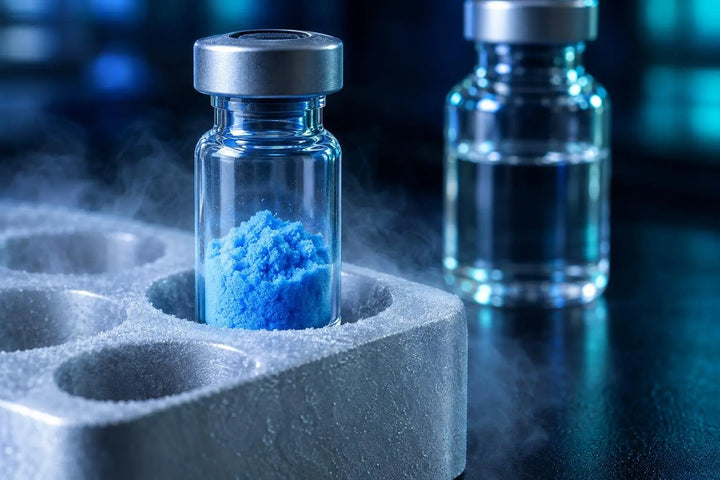
| Appearance | Blue lyophilized powder (copper complex) | Confirms GHK-Cu only |
What masses should the MS section show?
For the GLOW components, deconvoluted masses near 1419 g/mol (BPC-157), 4963 g/mol (TB-500) and 403 g/mol (the GHK-Cu complex); KLOW adds a peak near 342 g/mol for KPV. Large peptides such as TB-500 appear as a series of multiply charged ions that the instrument software deconvolutes to a single neutral mass, so the raw spectrum may look complicated; the reported mass is the number to compare. How the technique works is covered in mass spectrometry for peptide identity confirmation.
What does the colour tell you?
Only that copper is present. The blue of the powder and the solution comes from the GHK-Cu complex, and a colourless vial would be a reason to stop and check the certificate. But a blue powder could in principle be GHK-Cu alone, so colour is a first check and never a substitute for the MS data on the other components.
How do you read the HPLC section for a blend?
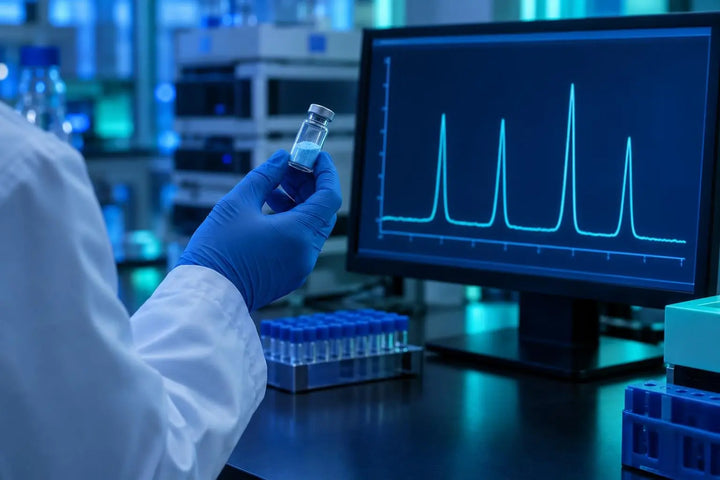
Per component. The certificate should state the purity of each peptide as the area of its main peak relative to its own impurities, rather than a single area percentage for the whole chromatogram. The catalog specification for the components is approximately 99% by HPLC. The method itself is explained in HPLC for peptides: how purity is measured.
What does the price of a blend reflect?
Queries about blend price are best answered by what the vial contains. Each component is synthesized by solid-phase chemistry, purified and analysed on its own before the three or four are co-formulated and lyophilized together, so the material carries several complete synthesis-and-QC sequences in one vial. The practical consequence for a buyer is the same as for any research material: the COA is the deliverable, and a lower price without per-component identity data is not a saving. The general sourcing checklist is in how to evaluate a research-compound supplier.
Related research guides
- GLOW peptide blend: components and in-vitro dermal research profile
- Sourcing KLOW: per-component COA and purity
- Multi-peptide research blends: terminology and composition conventions
- Reading a Certificate of Analysis line by line
- How to verify research peptide purity: a complete guide
Research-use note
All materials discussed are supplied for in vitro laboratory research use only, and are not for human or animal use.