GLOW is a co-formulated research blend of three synthetic peptides, BPC-157 (10 mg, CAS 137525-51-0), TB-500 (10 mg, CAS 77591-33-4) and GHK-Cu (50 mg, CAS 89030-95-5), supplied together as a single 70 mg lyophilized vial for in vitro research in dermal fibroblast and extracellular-matrix models. This profile covers what is in the vial, how the three components differ chemically, how the blend is framed in cell-culture work, and what a laboratory should check on the Certificate of Analysis before using it.
What is the GLOW peptide blend?
GLOW is a catalog name, not a chemical name. The vial contains three separately synthesized peptides that are combined before lyophilization, so the powder is a physical mixture rather than a new molecule. Each component keeps its own amino-acid sequence, molecular formula, molecular weight and CAS number, and each is confirmed separately on the COA. The listed component masses are 10 mg BPC-157, 10 mg TB-500 and 50 mg GHK-Cu, for a nominal 70 mg of peptide per vial; the exact ratio for a given lot is stated on that lot's certificate.
| Component | Listed mass per vial | Residues | CAS number | Formula | MW (g/mol) |
|---|---|---|---|---|---|
| BPC-157 | 10 mg | 15 | 137525-51-0 | C62H98N16O22 | 1419.5 |
| TB-500 | 10 mg | 43 | 77591-33-4 | C212H350N56O78S | 4963 |
| GHK-Cu | 50 mg | 3 (copper complex) | 89030-95-5 | C14H23CuN6O4 | 402.92 |
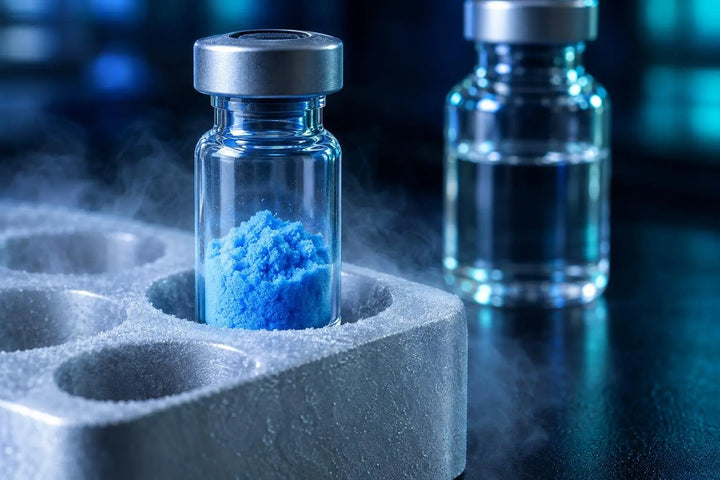
Because GHK-Cu is a copper complex, the lyophilized powder is pale blue rather than white. That colour is a useful first visual check that the copper peptide is present, although it says nothing about the other two components; identity for those rests on mass spectrometry, as described below.
How do the three components differ?
They are three different classes of molecule. BPC-157 is a 15-residue linear peptide (Gly-Glu-Pro-Pro-Pro-Gly-Lys-Pro-Ala-Asp-Asp-Ala-Gly-Leu-Val) whose sequence corresponds to a fragment of a gastric-juice protein; its chemistry is covered in the BPC-157 and TB-500 biochemical primer. TB-500 is the synthetic form of thymosin beta-4, a 43-residue, largely unstructured polypeptide carrying the conserved actin-binding motif LKKTET. GHK-Cu is the smallest: the tripeptide Gly-His-Lys coordinated to a divalent copper ion through the histidine imidazole and the terminal amine, which is why it is blue and why its handling differs from the other two (see GHK-Cu copper coordination chemistry).
On a molar basis the blend is far from equal. Dissolving the whole vial in 1 mL gives roughly 7.0 mM BPC-157, 2.0 mM TB-500 and 124 mM GHK-Cu, a molar ratio of about 3.5 : 1 : 62. Any experiment that compares the blend with its single components therefore has to be set up by molarity of each peptide, not by milligrams of powder. The arithmetic is worked through in the GLOW 70 mg vial concentration-math guide.
How is the GLOW blend framed for in vitro dermal research?
The three components are each individually studied in cell-culture models of connective tissue, which is why they are offered together. The in vitro questions are mechanistic: how a cultured dermal fibroblast population responds, in collagen and fibronectin synthesis, matrix-metalloproteinase expression and cell migration, when exposed to the blend at defined concentrations compared with vehicle and with each peptide alone. Useful assay designs are described in collagen and fibroblast assays in copper-peptide research and in the scratch-assay migration methods guide. The blend is a reagent for those assays; it is not a cosmetic preparation and no appearance or outcome claim is made for it.
A practical point for blend work: GHK-Cu carries copper, and copper ions alone can alter readouts in some assays. A copper-only control (copper chloride at the matched molarity) alongside the vehicle control separates peptide-dependent effects from metal-ion effects.
What should the GLOW COA show?
A single purity figure for the vial is not enough for a three-component product. The certificate should list, for each component, an HPLC purity and a mass-spectrometry identity, so that the reader can see that all three peptides are present at their expected masses (deconvoluted masses near 1419, 4963 and 403 g/mol) and that none is a substitute. How to read each line is covered in reading a COA line by line, and the blend-specific checks are collected in verifying a multi-component blend COA.
How does GLOW relate to KLOW?
KLOW is the four-component sibling: the same three peptides at the same listed masses plus 10 mg of the tripeptide KPV (Lys-Pro-Val), giving an 80 mg vial. The two blends are compared component by component in GLOW vs KLOW; the KLOW profile itself is at KLOW peptide blend.
Reconstitution and storage in brief
The lyophilized blend is reconstituted with reconstitution solution, swirled rather than shaken, and aliquoted so that each aliquot is thawed only once. Because the solution is blue, it is easy to see when the powder is fully dissolved. Stock solutions are stored frozen; working dilutions are prepared fresh in assay medium.
Related research guides
- What is GLOW peptide? Components, ratios and CAS numbers
- GLOW 70 mg vial: specification and stock concentration math
- Multi-peptide research blends: terminology and composition conventions
- Verifying a multi-component blend COA
- KLOW peptide blend: components and in-vitro research profile
- GHK-Cu: copper-binding chemistry and in vitro applications
Research-use note
All materials discussed are supplied for in vitro laboratory research use only, and are not for human or animal use.