The difference between GLOW and KLOW is one component: KLOW adds 10 mg of the tripeptide KPV (Lys-Pro-Val, CAS 67727-97-3) to GLOW's BPC-157 (10 mg), TB-500 (10 mg) and GHK-Cu (50 mg), raising the vial from 70 mg to 80 mg and adding a cytokine-signaling axis to the blend's fibroblast and matrix framing. This comparison lays the two compositions side by side, explains what KPV is, and sets out how to choose between the blends for an in vitro design.
GLOW vs KLOW at a glance
| Component | GLOW (70 mg) | KLOW (80 mg) | MW (g/mol) | Molarity in 1 mL |
|---|---|---|---|---|
| BPC-157 | 10 mg | 10 mg | 1419.5 | 7.0 mM |
| TB-500 | 10 mg | 10 mg | 4963 | 2.0 mM |
| GHK-Cu | 50 mg | 50 mg | 402.92 | 124 mM |
| KPV | none | 10 mg | 342.43 | 29 mM (KLOW only) |
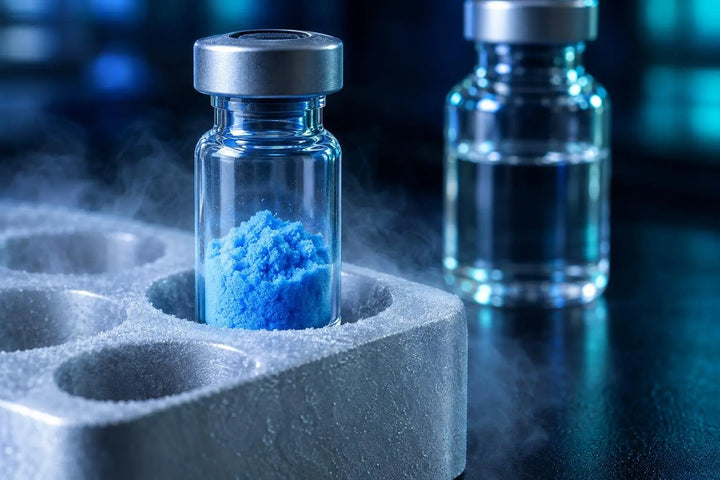
Everything in the first three rows is shared. GLOW and KLOW are the same three peptides at the same listed masses; the fourth row is the whole difference. Both are blue lyophilized powders because both contain the GHK-Cu copper complex.
What is KPV?
A tripeptide, Lys-Pro-Val, with the formula C16H30N4O4 and a molecular weight of 342.43 g/mol. Its sequence is the C-terminal fragment, residues 11 to 13, of alpha-melanocyte-stimulating hormone. In cell culture it is studied for its interaction with cytokine-signaling pathways, in particular NF-kB-dependent reporter and cytokine-secretion readouts, which is the research axis it brings to KLOW. KPV is supplied on its own as well, and its profile is KPV: a tripeptide in inflammation research.
What changes when KPV is added?
Three things. The mass goes from 70 to 80 mg, so the stock concentration of the three shared peptides is unchanged at any given volume (they are still 10, 10 and 50 mg per vial) while the solution carries an additional 10 mg/mL of KPV per millilitre. The molar picture shifts: in 1 mL, KLOW has roughly 29 mM KPV on top of GLOW's 7.0 mM BPC-157, 2.0 mM TB-500 and 124 mM GHK-Cu, so the two tripeptides together make up more than 90% of the molecules. And the readout set widens: GLOW is framed for fibroblast, collagen and matrix assays, described in collagen and fibroblast assays; KLOW adds cytokine-pathway readouts, described in cytokine signaling pathways in vitro.
Which blend fits which in vitro design?
GLOW when the question is about the three-peptide matrix model on its own: fibroblast collagen synthesis, metalloproteinase expression, migration in a scratch assay. KLOW when a cytokine-signaling readout is part of the same experiment and the design calls for KPV to be present at a fixed ratio with the other three. In either case the informative comparison is blend versus each single peptide at the molarity it has in the blend, plus a copper-only control, because the blend alone cannot say which component drives a readout. The component profiles are in GLOW peptide blend and KLOW peptide blend.
Do the COAs differ?
By one line set. A GLOW certificate carries three identities and three purities; a KLOW certificate carries four, with an additional mass-spectrometry peak near 342 g/mol for KPV. Either way the per-component data, not a single vial figure, is what confirms the composition; see verifying a multi-component blend COA.
Naming note
Queries phrased as "KLOW vs GLOW peptide" or "difference between GLOW and KLOW peptides" are asking this same composition question, and the answer is always KPV. Neither name is a chemical descriptor; the conventions for describing blends are in multi-peptide research blend terminology.
Related research guides
- GLOW peptide blend: components and in-vitro dermal research profile
- KLOW peptide blend: components and in-vitro research profile
- What is KLOW peptide? Component-by-component breakdown
- What is GLOW peptide? Components, ratios and CAS numbers
- KPV: a tripeptide in inflammation research
Research-use note
All materials discussed are supplied for in vitro laboratory research use only, and are not for human or animal use.