Sourcing KLOW as a research material means obtaining, in one Certificate of Analysis, the identity and purity data for all four of its components, BPC-157, TB-500, GHK-Cu and KPV, together with the lot ratio; a listing that offers a single purity figure for the 80 mg vial has not shown that all four peptides are present. This guide sets out what to ask for before ordering a four-component blend, how to read what arrives, and how KLOW is supplied in this catalog.
What makes sourcing a blend different?
With a single-peptide vial, one chromatogram and one mass spectrum settle identity and purity. A four-component vial multiplies that by four and adds a ratio. The sourcing questions for KLOW are therefore the same as for any research peptide, asked four times, plus one more: in what ratio. The general framework is in how to evaluate a research-compound supplier; the blend-specific layer is below.
What to ask for before ordering
| Ask for | Acceptable answer | Red flag |
|---|---|---|
| Component list | BPC-157, TB-500, GHK-Cu, KPV with CAS numbers | Components unnamed or without identifiers |
| Masses and ratio | Lot-specific mg per component | Only a total (80 mg) stated |
| HPLC purity | One value per component, about 99% | One value for the vial |
| MS identity | Observed mass per component | No MS data, or MS for one peptide only |
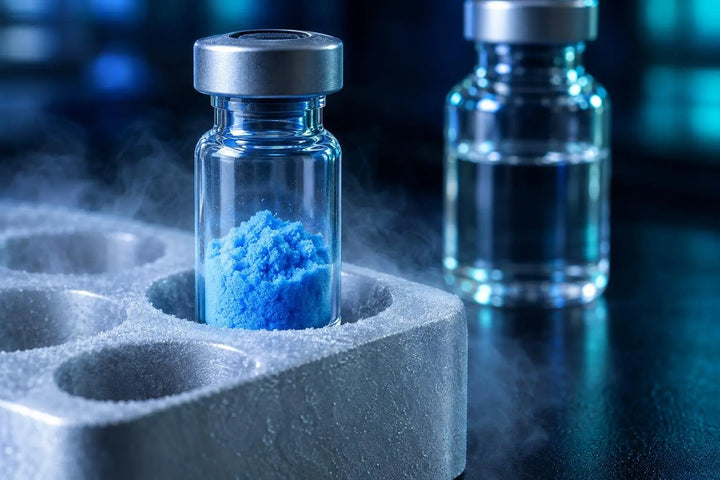
| Appearance | Blue lyophilized powder | White powder (copper complex absent) |
How do you read a KLOW COA when it arrives?
Match four observed masses to four expected molecular weights: near 1419 g/mol for BPC-157, 4963 for TB-500, 403 for the GHK-Cu complex and 342 for KPV. Then read four HPLC purities against the catalog specification of approximately 99%. Then carry the stated masses, not the listing's nominal 10 / 10 / 50 / 10 mg, into the concentration math. The line-by-line method is in reading a COA line by line, and the blend checklist is in verifying a multi-component blend COA.
What does per-component purity mean in practice?
That each peptide was purified and analysed on its own before co-formulation, so its impurity profile is known independently of the other three. HPLC purity for a blend reported as one number would combine four impurity profiles into a figure that cannot be interpreted. How HPLC purity is measured, and why the number is an area percentage rather than a mass fraction, is explained in HPLC for peptides.
How is KLOW supplied in this catalog?
As a single 80 mg lyophilized vial with the four components listed on the product page with their CAS numbers, formulas and molecular weights, and a lot-specific COA. The usual accessory is reconstitution solution; the handling notes and the 80 mg concentration math are in KLOW 80 mg handling and stability. Queries phrased as "KLOW peptide for sale" or "KLOW peptide buy" are, in practice, asking for a supplier that can produce this per-component documentation, and that is the test to apply.
Why does a verified blend cost what it does?
Because the vial carries four separate syntheses, four purifications and four sets of analytical work before co-formulation. A lower price offered without per-component data is not the same product with a smaller margin; it is a product whose composition has not been demonstrated.
Related research guides
- KLOW peptide blend: components and in-vitro research profile
- Verifying a multi-component blend COA
- KLOW 80 mg: copper-complex blue powder handling and stability
- How to evaluate a research-compound supplier
- How to verify research peptide purity: a complete guide
Research-use note
All materials discussed are supplied for in vitro laboratory research use only, and are not for human or animal use.