To prepare a TB-500 stock for in-vitro work, divide the vial mass by the solvent volume for mg/mL, then divide by the molecular weight (~4963 g/mol) for molarity. These are laboratory preparation figures, not an administration instruction.
What concentration does a 10 mg vial give?
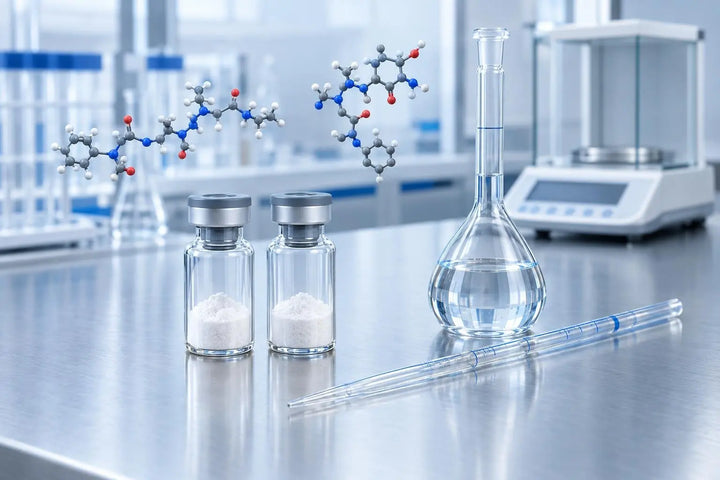
The TB-500 research material is supplied as a 10 mg lyophilized vial. Reconstituting 10 mg in 2 mL of bacteriostatic water gives 5 mg/mL; in 1 mL it gives 10 mg/mL. The same arithmetic scales to any vial mass a lab might hold, such as 5 mg (5 mg in 1 mL = 5 mg/mL).
| Vial | Solvent | Concentration |
|---|---|---|
| 10 mg | 1 mL | 10 mg/mL |
| 10 mg | 2 mL | 5 mg/mL |
| 5 mg | 1 mL | 5 mg/mL |
How do I convert mg/mL to molarity?
Molarity = (mg/mL) ÷ MW in g/mol, scaled to the units you want. At 5 mg/mL and MW 4963 g/mol, the stock is about 1.0 mmol/L (5 g/L ÷ 4963 g/mol ≈ 0.00101 mol/L). The full worked method is in the concentration and reconstitution math guide.
Why express it as concentration, not a dose?
In-vitro experiments are defined by the concentration a compound reaches in the assay well, so stocks are described in mg/mL or molarity. This is a laboratory preparation calculation only; see the TB-500 identity profile and stability notes for handling.
Related research guides
Research-use note
All materials discussed are supplied for in vitro laboratory research use only, and are not for human or animal use.