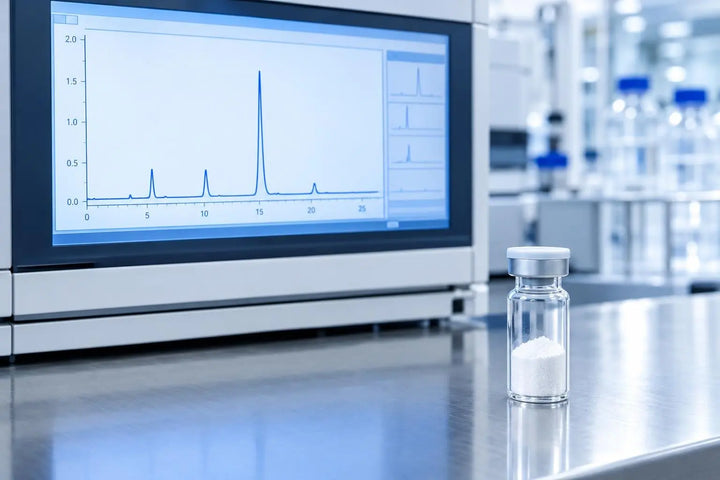
Tesofensine is studied in vitro with transporter-binding and uptake-inhibition assays in engineered cell lines expressing DAT, NET, or SERT. This guide outlines a compliant assay-design approach.
Choosing the model
Cell lines engineered to express a single monoamine transporter let researchers isolate tesofensine’s effect at DAT, NET, or SERT one transporter at a time.
Core readouts
- Binding affinity — how tightly the compound binds the transporter.
- Uptake inhibition — how much monoamine recovery is slowed in the assay, often reported as a concentration-response (EC50/IC50).
Controls
Vehicle controls, reference inhibitors, and replicates keep the data interpretable. Concentration is expressed in molarity or mg/mL, never as a dose.
Material quality
Reliable assays start with a well-characterized compound — source tesofensine with a batch COA.
Related research guides
- Tesofensine: monoamine-transporter research profile
- Tesofensine structure & transporter targets
- Sourcing tesofensine (COA, purity)
- Tesofensine vs other monoamine-reuptake compounds
Research-use note
All materials discussed are supplied for in vitro laboratory research use only, and are not for human or animal use.