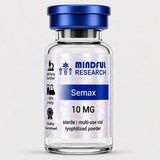
N-acetyl semax amidate is the modified research form of semax, carrying an acetylated N-terminus and an amidated C-terminus on the same MEHFPGP core; its identifiers are PubChem CID 172638603, molecular formula C39H54N10O10S, molecular weight ~855.0 g/mol.
What is N-acetyl semax amidate?
It is semax with two end-group modifications: the N-terminus is capped with an acetyl group and the C-terminal carboxyl is converted to an amide. The underlying sequence — Met-Glu-His-Phe-Pro-Gly-Pro — is unchanged from the parent semax peptide. Listings abbreviate it as “na semax amidate” or “n acetyl semax”.
Why are the termini modified?
Acetylation and amidation remove the free charged ends of the peptide. In solution-stability terms, capped termini resist exopeptidase trimming, which is why the acetyl-amidated form is a common research variant. The modifications change the molecular formula and mass but not the core residue sequence.
| Form | Formula | MW | CID |
|---|---|---|---|
| Semax | C37H51N9O10S | ~813.9 g/mol | 9811102 |
| N-acetyl semax amidate | C39H54N10O10S | ~855.0 g/mol | 172638603 |
How do you confirm which form you have?
Mass spectrometry distinguishes them directly: the acetyl-amidated form is about 41 mass units heavier than the free peptide, matching the ~855.0 vs ~813.9 g/mol difference. A COA should state the exact form and its matching formula. The sourcing and COA guide covers what to check, and the Semax product page states the form supplied.
Related research guides
- Semax Peptide: Structure, Naming and Identity
- Sourcing Semax Research Material: COA and Identity
- Semax: A Short Peptide and Its In-Vitro Research Targets
Research-use note
All materials discussed are supplied for in vitro laboratory research use only, and are not for human or animal use.