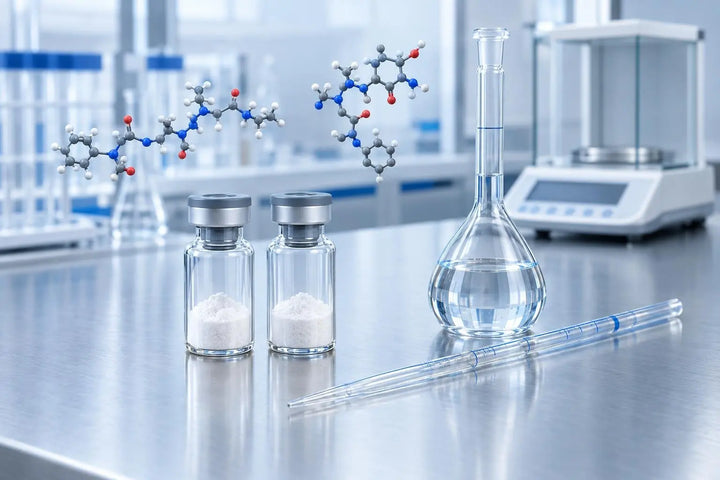
Visual inspection of a retatrutide vial cannot measure purity or confirm identity — appearance tells you almost nothing about what fraction of the material is the target peptide. This guide explains why analytical testing is the only reliable route.
What appearance can and cannot show
A lyophilized peptide usually looks like a small white cake or film. That appearance is consistent across many different peptides and purity levels, so it cannot distinguish retatrutide from a related molecule or reveal impurities.
Why purity needs instruments
Measuring purity means separating the sample and quantifying each component, which HPLC does. There is no visual cue that reports a percentage.
Why identity needs mass
Confirming identity means measuring molecular weight precisely, which mass spectrometry does. The eye cannot tell retatrutide from a closely related peptide.
The reliable path
Rely on a batch-specific COA backed by HPLC and mass spectrometry, not on how the material looks. Source retatrutide (RT-GLP3) with that documentation.
Find a COA: every RT-GLP3 batch report is listed in our certificate of analysis library, searchable by batch number.
Related research guides
- How to verify retatrutide purity (HPLC, MS, COA)
- Reading a retatrutide COA
- Why at-home kits can't measure purity
- Retatrutide identity confirmation by mass
Research-use note
All materials discussed are supplied for in vitro laboratory research use only, and are not for human or animal use.