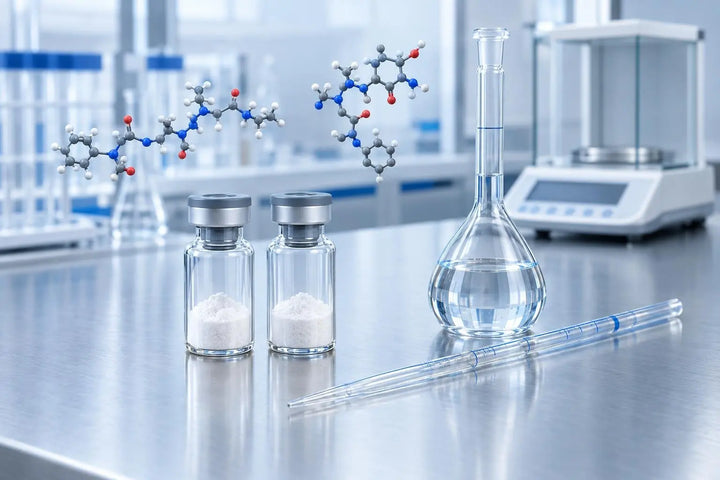
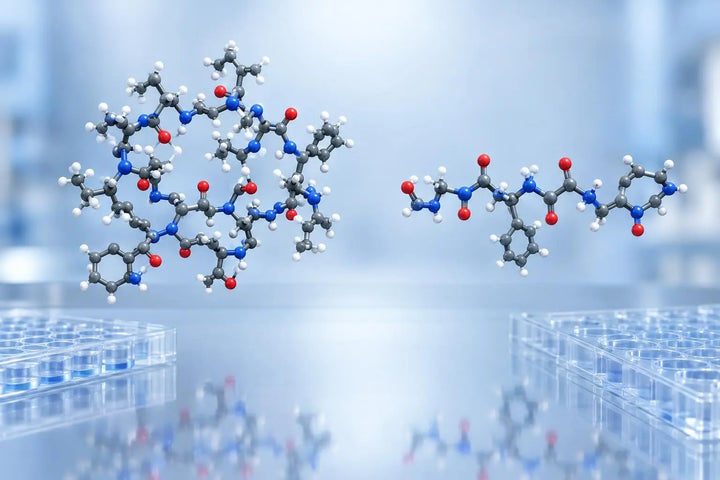
PT-141 and Melanotan II are two cyclic heptapeptide melanocortin-receptor agonists built on the same Ac-Nle-cyclo[Asp-His-D-Phe-Arg-Trp-Lys] ring, and they differ only at the C-terminus: PT-141 ends in a free carboxylic acid, Melanotan II in an amide. This guide compares PT-141 and MT-2 (Melanotan II) by structure and receptor selectivity in vitro.
How do the two structures compare?
| Property | PT-141 (bremelanotide) | Melanotan II |
|---|---|---|
| Ring system | Asp-Lys lactam, cyclic heptapeptide | Asp-Lys lactam, cyclic heptapeptide |
| Core motif | His-D-Phe-Arg-Trp | His-D-Phe-Arg-Trp |
| C-terminus | Free acid (-OH) | Amide (-NH2) |
| Formula | C50H68N14O10 | C50H69N15O9 |
| Molecular weight | 1025.18 g/mol | 1024.20 g/mol |
| CAS number | 189691-06-3 | 121062-08-6 |
How do they compare in receptor selectivity?
Both peptides are characterized in the research literature as non-selective agonists of the Gs-coupled melanocortin receptors MC1R, MC3R, MC4R, and MC5R, and neither is an MC2R ligand in the way ACTH is. Whether a one-atom C-terminal change shifts relative affinity or potency at a given subtype is an empirical question, best answered by profiling both peptides side by side in the same receptor-expressing cell lines. Background on the receptors is in the melanocortin receptor family primer.
How would you design a head-to-head in vitro comparison?
- Receptors: stable lines for MC1R, MC3R, MC4R, and MC5R, with the same passage and assay buffer.
- Binding: competition against a radiolabeled reference ligand to give Ki for each peptide.
- Function: cAMP accumulation to give EC50 and maximal response relative to a reference agonist.
- Concentrations: expressed in molarity across a half-log series, with both peptides prepared from stocks of confirmed concentration.
How do you confirm which peptide you have?
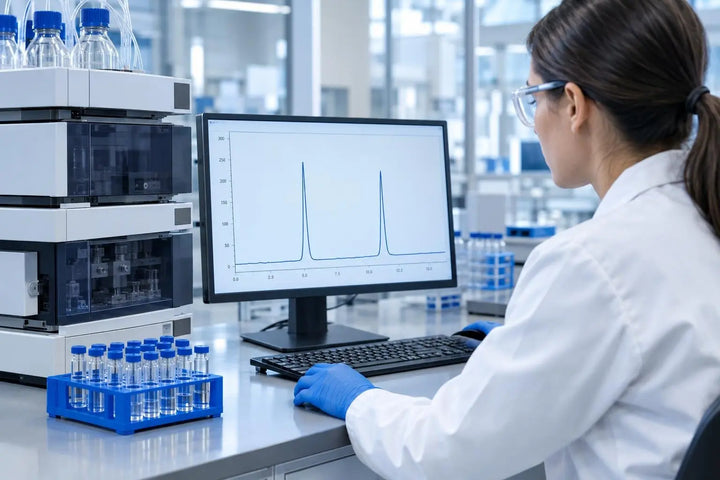
The two differ by 0.98 Da, so identity must be confirmed by mass spectrometry and CAS, not by label. The checks are covered in PT-141 name variants and mass-spec verification.
Related research guides
- PT-141 (bremelanotide): structure and melanocortin-receptor profile
- PT-141 10 mg vial: stock concentration math
- Sourcing PT-141 as a research material: COA and purity
Research-use note
All materials discussed are supplied for in vitro laboratory research use only, and are not for human or animal use.