"Wolverine peptide" is an informal online nickname for BPC-157; it is not a chemical name, and the underlying research material is simply the 15-residue peptide BPC-157 (C62H98N16O22).
Search interest in "wolverine peptide" and the plural "wolverine peptides" comes almost entirely from informal communities, not from the scientific literature. This article separates the nickname from the compound's documented identity.
Where does the nickname come from?
The nickname borrows a fictional character associated with rapid recovery. It is a marketing and forum shorthand, not a designation used in peer-reviewed research, where the compound is called BPC-157 or by its full sequence.
What is the compound behind the nickname?
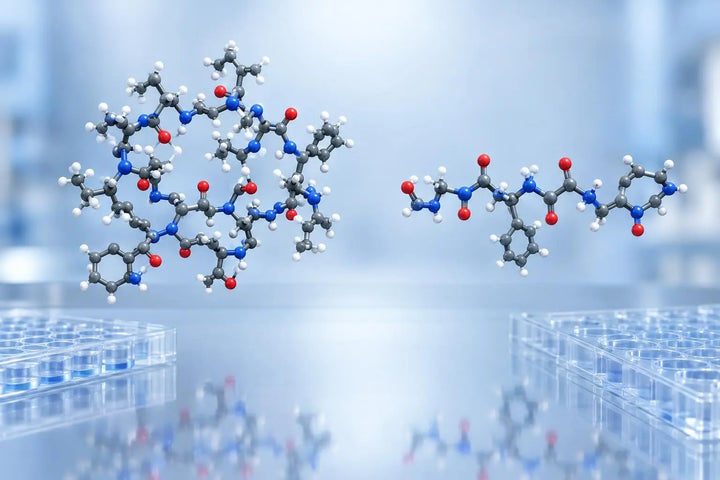
The compound is BPC-157, a synthetic pentadecapeptide with sequence GEPPPGKPADDAGLV, formula C62H98N16O22 and CAS 137525-51-0. For the full structural profile see our BPC-157 sequence and structure profile.
What do laboratory studies actually examine?
In vitro work with BPC-157 centers on mechanistic readouts: cell-migration and scratch assays, angiogenesis-related endpoints, and NO-system signaling. These describe cellular behavior in culture and do not establish any outcome in a living organism. Claims attached to the nickname should not be read as laboratory conclusions.
Why does the naming matter?
Using the precise name and sequence is what lets a lab match a certificate of analysis to the correct compound. A nickname cannot be verified against a mass spectrum; a sequence and formula can.
Related research guides
- BPC-157 pentadecapeptide: sequence and structure
- BPC-157 name variants (BP157, BCP157, BBC157)
- Cell-migration readouts in repair-peptide research
Research-use note
All materials discussed are supplied for in vitro laboratory research use only, and are not for human or animal use.