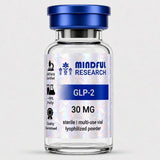
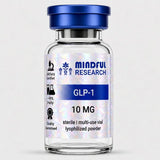
SM-GLP1, T-GLP2 and RT-GLP3 are research-catalog labels, not receptor classes: they map to semaglutide (a GLP-1 agonist), tirzepatide (a dual GIP/GLP-1 agonist) and retatrutide (a triple GLP-1/GIP/glucagon agonist) respectively.
What do the GLP-1 / GLP-2 / GLP-3 labels mean?
The “GLP-1 / GLP-2 / GLP-3” series in a research-peptide catalog is a numbering convention for three distinct incretin-mimetic compounds. The number indexes the catalog entry; it does not name a receptor the compound acts on. Only GLP-1 exists as a receptor in this set — “GLP-2” and “GLP-3” as used here are labels, which is why the incretin classes explainer notes there is no “GLP-3” hormone.
How do the labels map to compounds and receptors?
| Catalog label | Compound | Receptor targets (in vitro) |
|---|---|---|
| SM-GLP1 | Semaglutide | GLP-1 receptor (single agonist) |
| T-GLP2 | Tirzepatide | GIP + GLP-1 receptors (dual agonist) |
| RT-GLP3 | Retatrutide | GLP-1 + GIP + glucagon receptors (triple agonist) |
The count in each row — one, two, three receptors — is the useful pattern, not the label number. Each compound has its own profile: semaglutide, the tirzepatide (T-GLP2) identity, and RT-GLP3 (retatrutide).
Why is the naming confusing?
Because “GLP-2” and “GLP-3” are also terms used in hormone biology, the catalog labels can be mistaken for receptor assignments. They are not. For the specific GLP-2 case, see GLP-2 the hormone vs the T-GLP2 catalog label; for the retatrutide case, see is retatrutide a GLP-3.
How do I confirm which compound I have?
Ignore the label and check the CAS number and molecular formula on the listing and COA: semaglutide, tirzepatide (CAS 2023788-19-2, C225H348N48O68) and retatrutide each have distinct identifiers that a mass-spectrometry identity result confirms.
Related research guides
- Tirzepatide Peptide (T-GLP2): Identity and Structure
- GLP-2 the Hormone vs the T-GLP2 Catalog Label
- Is There Such a Thing as GLP-3? The Incretin Classes Explained
- Is Retatrutide a GLP-3? Clearing Up the Naming
Research-use note
All materials discussed are supplied for in vitro laboratory research use only, and are not for human or animal use.