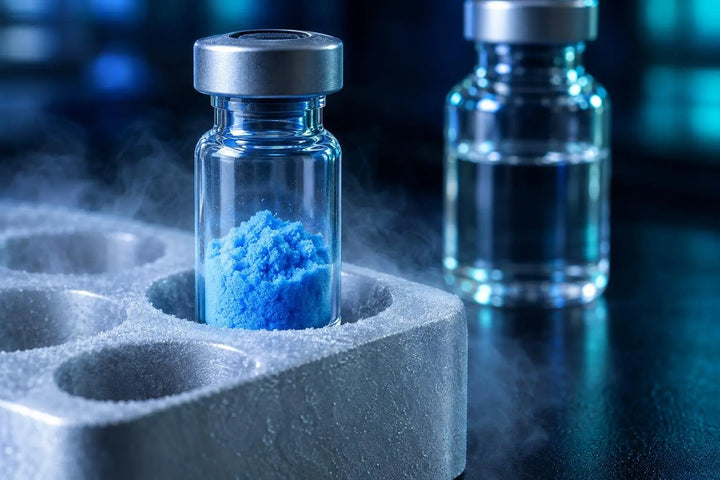
Reconstitution is dissolving a lyophilized (freeze-dried) peptide in a measured volume of solvent to make a solution of known concentration for laboratory work. This guide explains the science and the steps in plain language.
What does "reconstitute" mean?
Research peptides ship as a dry solid because removing water keeps them stable. Reconstitution adds a measured volume of an appropriate solvent to redissolve that solid, turning it into a liquid of a known concentration you can measure out for assays.
Why the solvent matters
Different peptides dissolve best in different solvents, depending on their chemistry. A common choice is bacteriostatic water; peptides that resist dissolving may need a mild acid such as a dilute acetic acid solution. The right solvent is the one that fully dissolves the peptide without degrading it.
How concentration works
The final concentration is set by two numbers: the mass of peptide in the vial and the volume of solvent you add. Concentration (milligrams per milliliter, or mg/mL) = peptide mass (mg) ÷ solvent volume (mL). Adding less solvent makes a more concentrated solution; adding more makes it more dilute.
Spelling out the units
Peptide masses are given in milligrams (mg) or micrograms (mcg), where 1,000 micrograms (mcg) = 1 milligram (mg). Volumes are in milliliters (mL) or microliters (µL), where 1 milliliter (mL) = 1,000 microliters (µL).
The basic steps
- Let the cold vial reach room temperature to avoid condensation.
- Draw up the planned volume of solvent.
- Add the solvent slowly down the inside wall of the vial, not directly onto the peptide cake.
- Let it dissolve gently; swirl rather than shake. The solution should become clear.
- Store cold and prepare working volumes fresh for each assay.
Related research guides
- Choosing a reconstitution solvent
- Bacteriostatic water explained
- Why some peptides won't dissolve
- Aliquoting and freeze-thaw
- 0.6% acetic acid for basic peptides
Research-use note
All peptides discussed are supplied for in vitro laboratory research use only. This describes laboratory preparation of a solution, not any use in a person or animal.