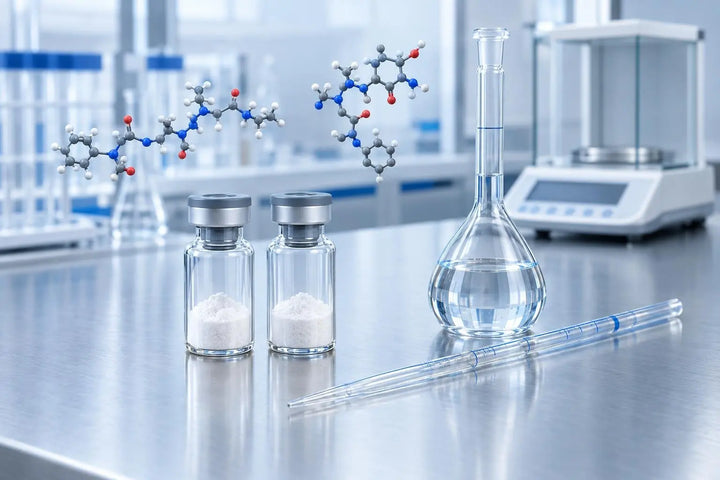
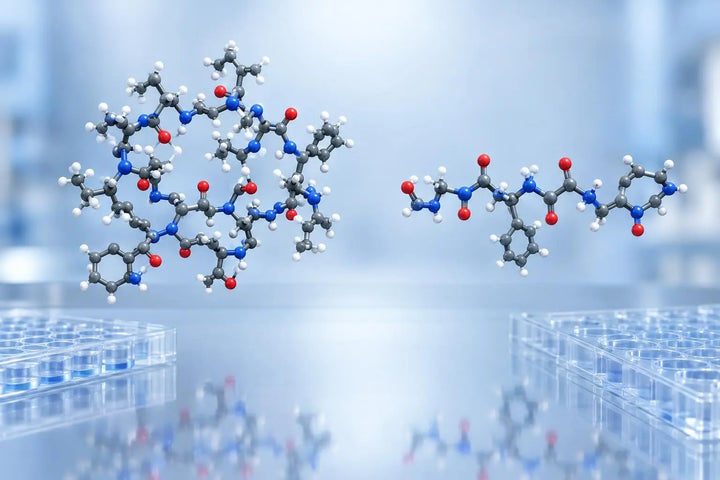
In NNMT research, 5 amino 1mq is studied in enzymatic and cell-based assays that track methyl transfer from SAM to nicotinamide and the knock-on effects for the NAD+ salvage pathway.
This guide outlines how NNMT activity and its inhibition are measured in vitro, and why the enzyme connects methylation chemistry to NAD+ recycling.
What reaction does NNMT catalyse?
NNMT transfers a methyl group from S-adenosyl-L-methionine (SAM) onto nicotinamide, yielding 1-methylnicotinamide (1-MNA) and S-adenosyl-L-homocysteine (SAH). Nicotinamide is also a substrate for the NAD+ salvage pathway, so NNMT activity competes with NAD+ recycling for a shared pool of nicotinamide. That branch point is why the enzyme is studied in metabolic and cellular research contexts.
How is NNMT activity measured in vitro?
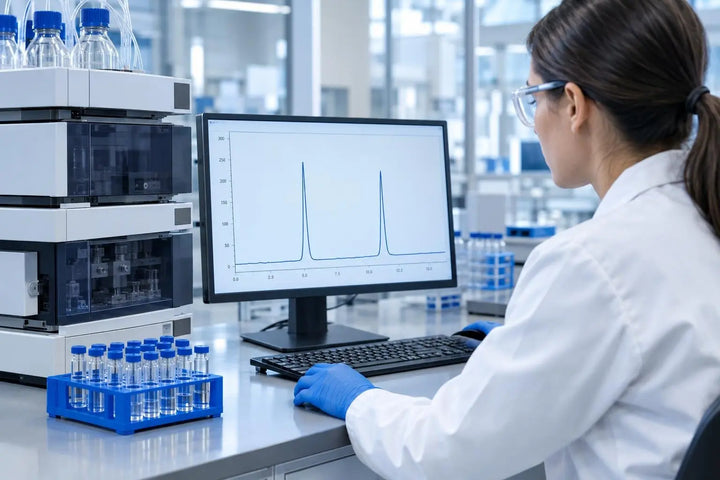
Enzymatic assays use recombinant NNMT with SAM and nicotinamide, then quantify a product or cofactor: 1-MNA by fluorescence or LC-MS, or SAH by coupled assays that read the methyltransferase turnover. Inhibition by a small molecule such as 5-Amino-1MQ is reported as an IC50 against this activity. Because the compound is nicotinamide-competitive, assays often vary substrate concentration to describe the inhibition pattern. General methodology for affinity and turnover sits in binding assays and metabolic enzyme assays.
How does it connect to NAD+ in cell models?
In cell-based work, researchers read methylation flux (1-MNA output) alongside intracellular NAD+/NADH levels to see how shifting the nicotinamide balance tracks with the salvage pathway. Those NAD+ measurements are covered in quantifying NAD+ and NADH in vitro, with the wider pathway context in NAD+ and its precursors.
What controls belong in the design?
Typical controls include a no-enzyme blank, a no-inhibitor reference, a vehicle-matched control for the solvent used to prepare the stock, and a standard curve for the product being quantified. Concentrations are expressed in molarity or mg/mL. The compound and its chemistry are described in the 5-Amino-1MQ research profile; the material itself is the 5-Amino-1MQ listing.
Related research guides
- 5-Amino-1MQ: NNMT-Inhibitor Chemistry and In-Vitro Research Profile
- Quantifying NAD+ and NADH In Vitro: Assay Approaches
- NAD+ and Its Precursors: An In-Vitro Research Overview
- Metabolic Enzyme Assays In Vitro
Research-use note
All materials discussed are supplied for in vitro laboratory research use only, and are not for human or animal use.