NAD+ (nicotinamide adenine dinucleotide) is a central coenzyme in cellular biochemistry, and it is studied in vitro alongside its precursors as research materials. This overview introduces the molecule, its precursors, and the assays used to study them.
What is NAD+?
NAD+ is a coenzyme that participates in redox reactions and other cellular processes. It is not a peptide; it is a small-molecule dinucleotide, and it is handled as a research material in the laboratory.
The precursor molecules
Cells can build NAD+ from precursor molecules, and these precursors are studied as distinct research materials, each with its own chemistry and handling considerations.
The NAD+/NADH redox pair
NAD+ and its reduced form, NADH, make up a redox pair that is fundamental to energy metabolism. The balance between the two is a frequent readout in cell-based studies.
How these are studied in vitro
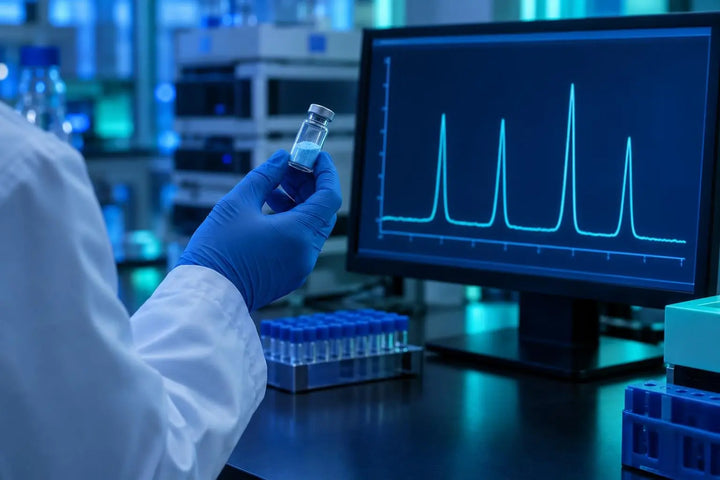
Researchers quantify NAD+ and NADH with biochemical assays, and use these measurements to study the coenzyme's role in cell models under controlled conditions. The nicotinamide pool that feeds NAD+ salvage is also drawn on by the enzyme NNMT, which is why a small-molecule NNMT inhibitor such as 5-Amino-1MQ is studied in the same metabolic context.
Reading this cluster
The supporting guides below cover the choice between precursors, the NAD+/NADH redox pair, the molecule's dual roles, and why NAD+ is not a peptide.
Related research guides
- Quantifying NAD+/NADH in vitro
- NAD precursors: NMN vs NR vs NAM
- NAD+ vs NADH: the redox pair
- The dual role of NAD+
- Why NAD+ is not a peptide
- NNMT, NAD+ salvage and SAM: assay design
Research-use note
All materials referenced are supplied for in vitro laboratory research use only. They are not for human or animal use.
Related research: Glutathione.