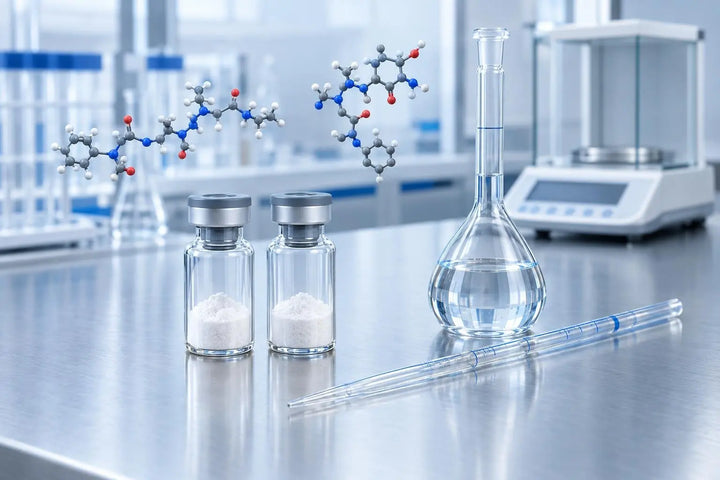
When sourcing 5-Amino-1MQ for sale as a research material, the decisive checks are a batch certificate of analysis, HPLC purity, and mass-spectrometry identity — not price alone.
5-Amino-1MQ is a small-molecule salt, so sourcing hinges on documented identity and purity for the specific batch. This guide lists what a research listing should show.
What should a listing document?
At minimum: the compound name and systematic name (5-amino-1-methylquinolinium), the salt form (iodide), the CAS number (42464-96-0), molecular formula and weight (C10H11IN2, 286.11 g/mol for the salt; C10H11N2+, 159.21 g/mol for the cation), stated purity (for example ~99% by HPLC), and a batch-specific COA. A general framework for judging a supplier is in how to evaluate a research-compound supplier.
How do you read the COA?
A certificate should tie a batch number to an HPLC purity figure and a mass-spectrometry result that matches the expected mass. Walking a certificate line by line is covered in reading a COA line by line, and the purity method itself in how HPLC measures purity. Identity by mass is in mass spectrometry for identity.
Why does salt form matter when sourcing?
Because the supplied solid is the iodide salt (286.11 g/mol) while the active cation is 159.21 g/mol, concentration math must use the salt mass actually weighed. That calculation and storage are handled in the solubility and storage guide. The research material is the 5-Amino-1MQ listing, and reconstitution solution is a common complementary reagent.
Related research guides
- 5-Amino-1MQ: NNMT-Inhibitor Chemistry and In-Vitro Research Profile
- How to Evaluate a Research-Compound Supplier
- Reading a Certificate of Analysis (COA) Line by Line
- HPLC for Peptides: How Purity Is Measured
Research-use note
All materials discussed are supplied for in vitro laboratory research use only, and are not for human or animal use.