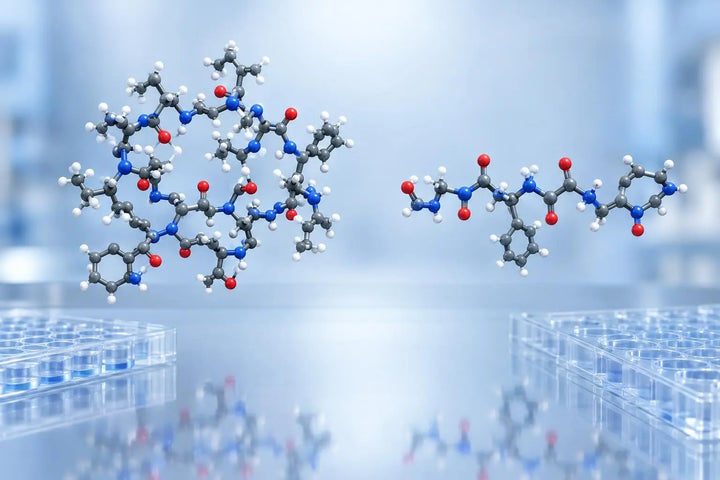
Tesamorelin is a synthetic 44-residue peptide, a trans-3-hexenoyl analog of human growth-hormone-releasing hormone GRF(1-44), studied in vitro as a stabilized agonist of the GHRH receptor. This pillar guide maps its structure, the receptor signaling it is used to probe, how the material is characterized in the laboratory, and where each topic is covered in depth.
What is tesamorelin?
Tesamorelin keeps the complete 44-residue sequence of human GHRH, with a C-terminal amide, and adds a trans-3-hexenoyl group to the N-terminal tyrosine. In a research setting it serves as a long-lived GHRH-receptor agonist for cell-culture work where the native hormone would be degraded too quickly. The table summarizes the identifiers carried on the product page.
| Property | Value |
|---|---|
| Class | GHRH analog (GRF(1-44) with N-terminal trans-3-hexenoyl group) |
| Length | 44 amino acids, C-terminal amide |
| Receptor | GHRH receptor (class B G protein-coupled receptor) |
| CAS (as listed) | 901758-09-6 |
| Formula and mass (as listed) | C223H370N72O69S, 5195.908 g/mol |
| Research form | Lyophilized powder, about 99% purity by HPLC, batch documentation |
Why does the N-terminal modification matter?
Native GHRH begins Tyr-Ala, a motif recognized by dipeptidyl peptidase IV, which removes the first two residues and leaves an inactive fragment. Acylating the N-terminus with a trans-3-hexenoyl group makes the peptide a poorer substrate for that cleavage, so it keeps its activity far longer in media that contain peptidases. The sequence, the mass shift and the stability liabilities are worked through in the sequence and stability guide listed at the end of this article.
What receptor pathway does it probe?
The GHRH receptor couples to Gs, which activates adenylyl cyclase, raises intracellular cAMP and activates protein kinase A and CREB, ultimately driving growth-hormone gene transcription and secretion in pituitary somatotroph models. Typical in vitro readouts are cAMP accumulation, CRE-reporter activity and growth-hormone release from cultured pituitary cells. Because this is a different receptor class from the ghrelin receptor, it pairs naturally with the comparison in GHRH analogs versus GH secretagogues.
How does it compare with related peptides?
| Compound | Length | Receptor | Key structural feature |
|---|---|---|---|
| Tesamorelin | 44 aa | GHRH receptor | Full-length GRF(1-44), N-terminal trans-3-hexenoyl |
| Sermorelin | 29 aa | GHRH receptor | Truncated GRF(1-29)-NH2, unmodified N-terminus |
| Ipamorelin | 5 aa | Ghrelin (GHS) receptor | Synthetic pentapeptide, different receptor class |
For a head-to-head comparison of the two receptor classes see ipamorelin versus tesamorelin for in vitro research.
How is the material characterized and handled?
Identity is confirmed by mass spectrometry, purity by reverse-phase HPLC, and both are documented on a batch-specific certificate of analysis. Stock concentrations are calculated from the molecular weight in mg/mL and molarity, and solutions are aliquoted to limit freeze-thaw cycles. The sections below point to the detailed guides for each of these steps.
Where to source tesamorelin as a research material
Happy Peptides supplies Tesamorelin as a 10 mg lyophilized vial with batch documentation. The checklist for evaluating any supplier's certificate is in sourcing tesamorelin as a research material.
Related research guides
- Tesamorelin Peptide: Sequence, N-terminal Modification and Stability
- Tesamorelin 10 mg / 5 mg Vials: Stock Concentration Math (In Vitro)
- What Drives Tesamorelin Research-Material Cost: Synthesis Length, Purity, COA
- GHRH-Receptor Binding and cAMP Assay Design for Tesamorelin
- "Tesa" / Tesamorelin Naming: Confirming Compound Identity by CAS and MS
Research-use note
All materials discussed are supplied for in vitro laboratory research use only, and are not for human or animal use.