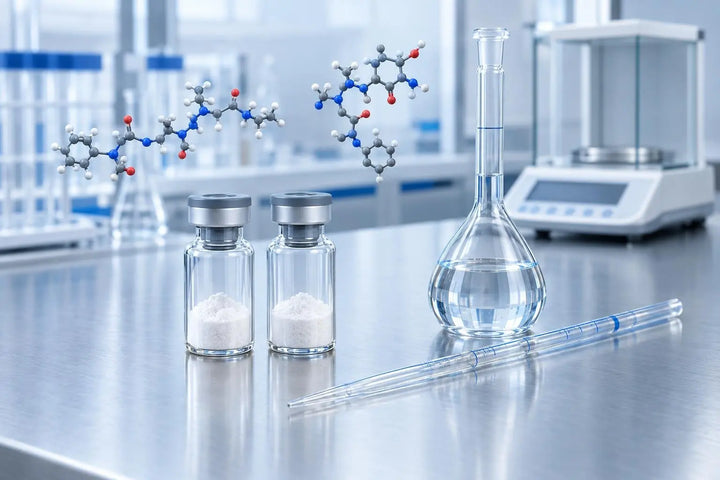
A tesamorelin 10 mg vial contains about 1.92 micromoles of peptide (10 mg divided by 5195.908 g/mol), so the stock concentration is set entirely by the solvent volume: 10 mg in 1 mL gives 10 mg/mL, or about 1.92 mM. This guide works through the arithmetic for Tesamorelin for in vitro assay preparation, and includes 5 mg values for researchers working from a smaller weighed amount. For the peptide itself see the tesamorelin structure and in-vitro research profile.
How do you convert mg per mL to molarity?
Molarity (mol/L) equals mass concentration (g/L) divided by molecular weight (g/mol). With the listed molecular weight of 5195.908 g/mol, 1 mg/mL equals 1 g/L, which is 0.192 mM. Happy Peptides lists tesamorelin as a 10 mg vial; the 5 mg column below applies when working from a different vial format or a smaller weighed amount of material.
What stock concentrations result from common solvent volumes?
| Solvent volume | 10 mg (mg/mL) | 10 mg (mM) | 5 mg (mg/mL) | 5 mg (mM) |
|---|---|---|---|---|
| 1 mL | 10.0 | 1.92 | 5.0 | 0.96 |
| 2 mL | 5.0 | 0.96 | 2.5 | 0.48 |
| 3 mL | 3.33 | 0.64 | 1.67 | 0.32 |
| 5 mL | 2.0 | 0.38 | 1.0 | 0.19 |
| 10 mL | 1.0 | 0.19 | 0.5 | 0.10 |
How do you dilute a stock to assay concentrations?
Use C1 x V1 = C2 x V2. A 1.92 mM stock diluted 1:100 in assay buffer gives 19.2 micromolar; further 1:10 or half-log steps carry the series into the nanomolar and picomolar range needed to define a full concentration-response curve in a GHRH-receptor cAMP assay. Keep final solvent content identical across every well, including the vehicle control. A suitable aqueous solvent such as Reconstitution Solution is a common choice for aqueous stocks; follow the solvent's own documentation, and the solvent trade-offs are covered in why some peptides will not dissolve.
What affects the accuracy of the math?
- Which molecular weight you use: the listed 5195.908 g/mol corresponds to the acetate form. The parent peptide is about 5135.9 g/mol, which would give 1.95 micromoles per 10 mg, a difference of roughly 1.2%.
- Net peptide content: lyophilized powder includes counter-ions and residual water, so true peptide mass is below the label mass. Use the content figure from the certificate of analysis where it is provided.
- Handling: prepare single-use aliquots and use low-bind plastic, since a 44-residue peptide can adsorb to surfaces at low concentrations.
Related research guides
Research-use note
All materials discussed are supplied for in vitro laboratory research use only, and are not for human or animal use.