Tesamorelin research-material cost is driven mainly by its 44-residue synthesis length, the purification needed to reach a stated HPLC purity, the extra N-terminal acylation step, and the analytical testing behind the certificate of analysis. Understanding these factors helps a lab compare listings on price per milligram of verified peptide rather than on sticker price alone. See the tesamorelin structure and in-vitro research profile for the compound itself.
Why does synthesis length raise tesamorelin cost?
Solid-phase synthesis builds the chain one residue at a time, so small coupling losses compound. The theoretical share of full-length chains falls steeply with length:
| Peptide length | At 99.0% per coupling | At 99.5% per coupling |
|---|---|---|
| 5 residues (ipamorelin-sized) | 95% | 98% |
| 29 residues (sermorelin-sized) | 75% | 86% |
| 44 residues (tesamorelin) | 64% | 80% |
The crude product therefore contains many deletion and truncation sequences that elute close to the target on RP-HPLC, and removing them takes repeated preparative runs that cut final yield.
What else adds to the cost?
- N-terminal acylation: attaching the trans-3-hexenoyl group is an additional chemical step and a further impurity to monitor.
- Purity specification: each step up in HPLC purity costs yield, so a higher stated purity means more material discarded.
- Analytical testing: HPLC, mass spectrometry and batch-specific third-party verification are fixed costs spread over a small number of vials.
- Salt form and content: acetate counter-ions and residual water mean the vial holds less peptide than its label mass.
How do you compare tesamorelin price fairly?
Compare cost per milligram of target peptide: listing price divided by (label mass x net peptide content x HPLC purity). As an illustration only, a 10 mg vial at 80% net content and 99% purity holds about 7.9 mg of target peptide, so a listing is cheaper than it looks only if the COA supports those numbers. A low price without batch documentation is not comparable. The documentation checklist is in sourcing tesamorelin as a research material, and the current listing for Tesamorelin is on its product page.
What should the COA show?
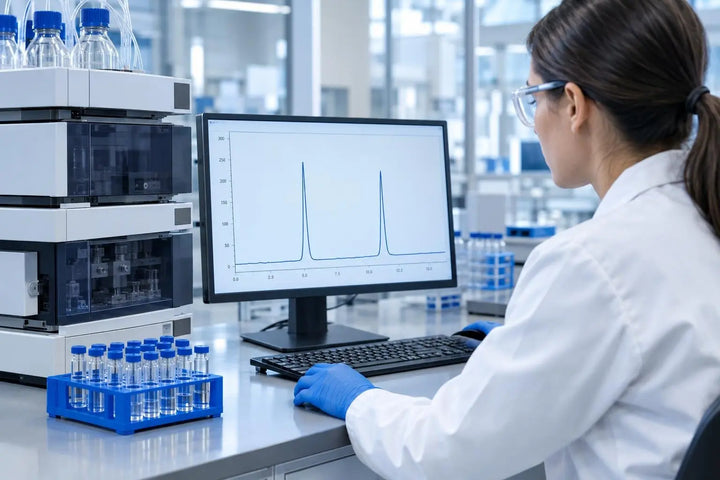
A batch-specific COA should report HPLC purity with the chromatogram, an observed mass matching the expected value, and the net peptide content. How to read each line is explained in reading a COA line by line.
Related research guides
Research-use note
All materials discussed are supplied for in vitro laboratory research use only, and are not for human or animal use.