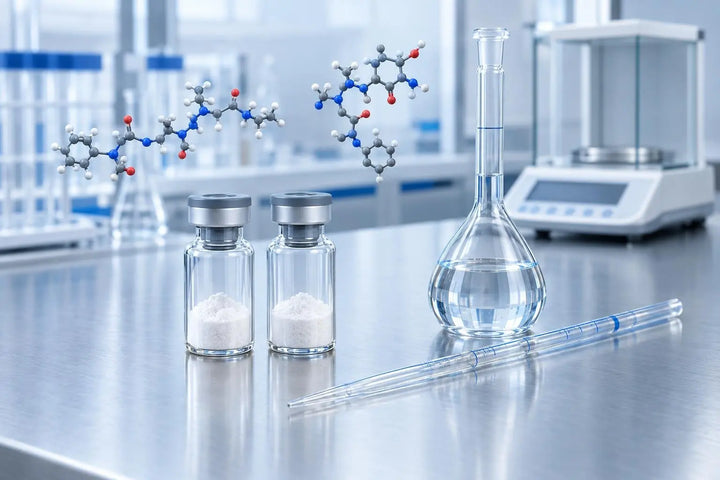
The solvent volume a lab buys is driven by how much peptide it reconstitutes and the concentration it needs — 3 mL is a common research size, while larger volumes suit higher-throughput work. This guide explains how to choose.
Why volume matters
Concentration (mg/mL) equals the peptide mass in the vial divided by the solvent volume added. So the volume on hand sets how concentrated a reconstituted solution can be and how many preparations one bottle of solvent covers.
When 3 mL is enough
A 3 mL reconstitution solution covers typical single-vial reconstitution and small assay runs. It is the common research default.
When to size up
Labs reconstituting many vials, or preparing larger working volumes, draw down solvent faster and benefit from larger fills or multiple units. Match the total solvent you stock to your experiment cadence. For the purchase-side math (waste, puncture count and cost per mL), see 10 mL vs 30 mL bacteriostatic water.
Related research guides
- Bacteriostatic water for peptides: the full lab guide
- Sourcing reconstitution solvents
- 0.6% acetic acid: spec & when labs use it
- Bacteriostatic vs sterile water
- Reconstitution-solution buyer's guide
Research-use note
All materials discussed are supplied for in vitro laboratory research use only, and are not for human or animal use.