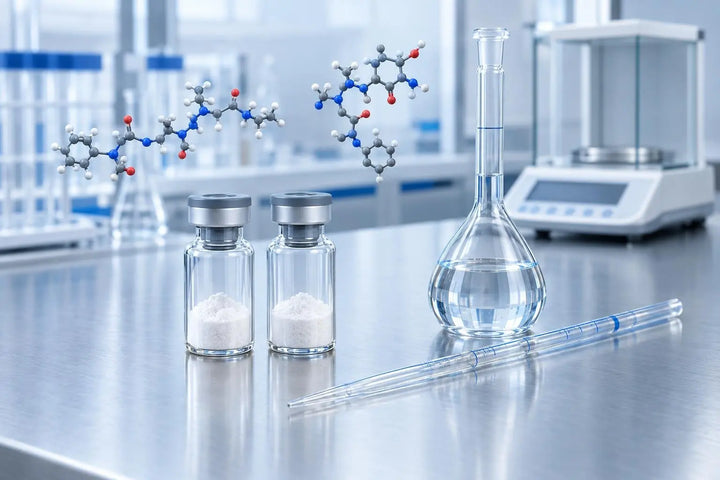
Reconstitution solvents for research peptides are the sterile liquids a lab uses to redissolve a lyophilized peptide into a solution of known concentration — most often bacteriostatic water, and, for peptides that resist dissolving, a dilute (0.6%) acetic acid solution. This guide covers what to look for when sourcing them and which solvent fits which material.
What counts as a reconstitution solvent?
A reconstitution solvent is the liquid added to a dry peptide cake to redissolve it for laboratory work. The two most common in research supply are bacteriostatic water (water with a small amount of preservative; see the bacteriostatic water for peptides guide) and a dilute acetic acid solution for basic, hard-to-dissolve peptides. Both are stocked as reconstitution solution products.
What to check when sourcing a solvent
- Closure integrity and fill: the solvent should arrive sealed and batch-tested (see the batch Certificate of Analysis), in a vial sized to the volumes your protocol uses.
- Preservative vs plain: bacteriostatic water carries a preservative for multi-draw use; plain sterile water does not.
- Acid concentration: for basic peptides, a defined dilute acetic acid concentration (commonly 0.6%) is what aids solubility.
- Volume options: 3 mL is a common research size; larger volumes suit higher-throughput work.
Which solvent for which peptide?
Start from the peptide’s documentation. If it dissolves cleanly in bacteriostatic water, that is the default. If it leaves undissolved material, a dilute acetic acid solution is the usual next step. The right solvent is the one that fully dissolves the material without degrading it.
Where to buy
Happy Peptides stocks both a reconstitution solution and a dilute acetic acid solution as research materials, in research-appropriate sizes.
Related research guides
- Bacteriostatic water for peptides: the full lab guide
- 0.6% acetic acid: spec & when labs use it
- Bacteriostatic vs sterile water
- Choosing 3 mL vs larger solvent volumes
- Reconstitution-solution buyer's guide
Research-use note
All materials discussed are supplied for in vitro laboratory research use only, and are not for human or animal use.