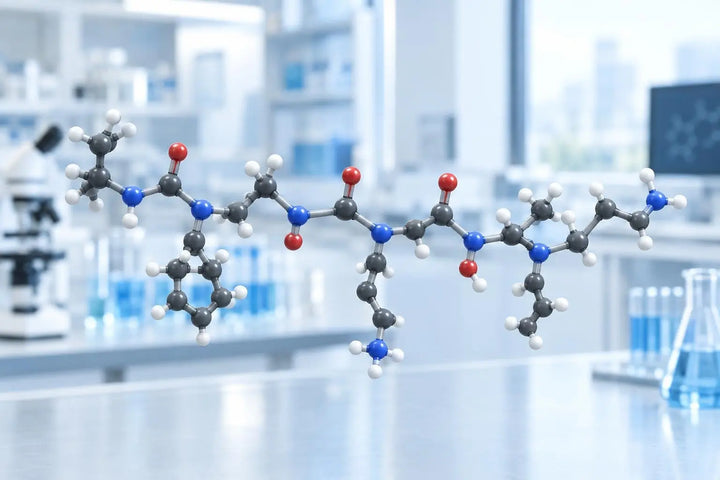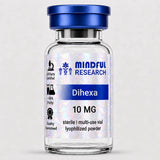
“Dihexa acetate” is the acetate salt form of dihexa (PNB-0408, CAS 1401708-83-5); the free compound and its acetate salt share the same C27H44N4O5 peptide backbone and differ only in the associated counterion.
What is dihexa acetate?
Many synthetic peptides and peptide-like compounds are isolated as salts. The acetate salt pairs the basic sites of the molecule with acetate counterions, which is a common, low-interference alternative to the trifluoroacetate (TFA) salts left over from purification. The counterion does not change the covalent structure of dihexa itself — the hexanoyl-Tyr-Ile-aminohexanoic-amide backbone is identical — so the acetate form and the free form carry the same molecular identity in an assay.
Why do spellings like “di hexa” and “dihexa peptide” appear?
Search and catalog listings show several surface variants of the same name: the one-word dihexa, the spaced di hexa, and the descriptive dihexa peptide. These all refer to the single compound PNB-0408. The underlying identity is fixed by the CAS number and formula, not by the spelling, so confirming those identifiers (covered in the dihexa identity and structure guide) is the reliable way to resolve a naming variant.
What are dihexa's other names?
The table below lists the names a researcher is likely to encounter for the same molecule.
| Name / code | Type |
|---|---|
| Dihexa | Common name |
| PNB-0408 | Development code |
| ATH-1001 | Development code |
| Hexanoyl-Tyr-Ile-Ahx-NH2 | Sequence shorthand |
| N-hexanoic-Tyr-Ile-(6)aminohexanoic amide | Descriptive chemical name |
| CAS 1401708-83-5 | Registry identifier |
Does the salt form change identity verification?
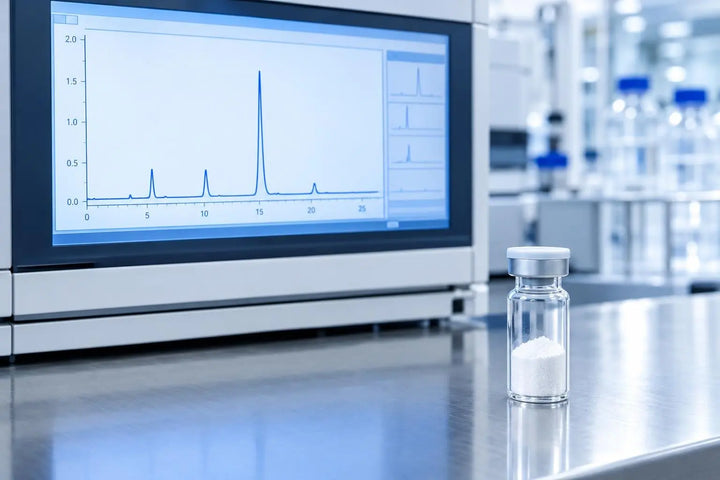
No. Mass-spectrometry identity checks target the same backbone mass whichever salt the material is isolated as, so a COA confirms the C27H44N4O5 identity regardless of counterion. Where a supplier needs to quantify the acetate content specifically, that is measured separately (for example by ion chromatography) and reported alongside the HPLC purity figure. See the sourcing and COA guide for how these values fit together.
Related research guides
- Dihexa Explained: Angiotensin IV Analog and HGF–c-Met Identity
- Sourcing Dihexa Research Material: COA and Identity
- Dihexa 5 mg / 10 mg Vials: Stock Concentration Math
- Growth-Factor Receptor Signaling In Vitro: RTKs and PI3K-Akt
Research-use note
All materials discussed are supplied for in vitro laboratory research use only, and are not for human or animal use.