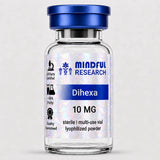
Dihexa (PNB-0408) is a synthetic angiotensin IV–derived oligopeptide (CAS 1401708-83-5, molecular formula C27H44N4O5, molecular weight ~504.7 g/mol) used in vitro as a high-affinity reference ligand for the hepatocyte growth factor (HGF) / c-Met receptor tyrosine kinase signaling axis.
What is dihexa?
Dihexa is a small synthetic oligopeptide analog built on the N-terminal portion of angiotensin IV. In the research literature and across supplier catalogs it also appears as the dihexa peptide, under the development code PNB-0408 (and ATH-1001), and under the descriptive chemical name N-hexanoic-Tyr-Ile-(6)aminohexanoic amide. It is handled strictly as an in vitro reference compound for studying receptor signaling, not as a finished product.
What is the molecular structure of dihexa?
Structurally, dihexa is a modified dipeptide scaffold: an N-terminal hexanoyl (hexanoic acid) cap, a tyrosine residue, an isoleucine residue, and a C-terminal 6-aminohexanoic amide (Ahx-NH2) tail. The two non-standard termini — the fatty hexanoyl group and the aminohexanoic amide — are what distinguish it from the native peptide fragment it is derived from and are associated with its resistance to aminopeptidase cleavage in assay buffers. Its verified identifiers are summarized below.
| Identifier | Value |
|---|---|
| Chemical name | N-(1-Oxohexyl)-L-tyrosyl-N-(6-amino-6-oxohexyl)-L-isoleucinamide |
| Synonyms | PNB-0408, ATH-1001, Hexanoyl-Tyr-Ile-Ahx-NH2 |
| CAS number | 1401708-83-5 |
| PubChem CID | 129010512 |
| Molecular formula | C27H44N4O5 |
| Molecular weight | ~504.7 g/mol |
| UNII | 9WYX65A5C2 |
The IUPAC name is (2S,3S)-N-(6-amino-6-oxohexyl)-2-[[(2S)-2-(hexanoylamino)-3-(4-hydroxyphenyl)propanoyl]amino]-3-methylpentanamide, reflecting the defined (S)-stereochemistry at the tyrosine and isoleucine centers.
How does dihexa relate to angiotensin IV?
Angiotensin IV is the hexapeptide Val-Tyr-Ile-His-Pro-Phe, a fragment of the renin–angiotensin system. Dihexa was designed around the Tyr-Ile core of that sequence, with the flanking residues replaced by the hexanoyl and aminohexanoic-amide groups. This places dihexa in the family of angiotensin IV (AT4) analogs that are studied as ligands at the AT4 site / insulin-regulated aminopeptidase (IRAP) and as modulators of growth-factor receptor signaling in cell-based assays.
What signaling pathway is dihexa used to study in vitro?
The most-cited in vitro property of dihexa is its interaction with the hepatocyte growth factor (HGF) system and the c-Met receptor. c-Met is a receptor tyrosine kinase (RTK), so experiments with dihexa are typically framed around RTK activation readouts — receptor phosphorylation, downstream PI3K–Akt and MAPK signaling, and cell-based scatter or migration assays. For the broader assay context, see our overview of growth-factor receptor signaling in vitro (RTKs and PI3K–Akt). Researchers sourcing the compound itself can review the Dihexa research-material listing for specification details.
Related research guides
- Sourcing Dihexa Research Material: COA and Identity
- Dihexa Acetate and Naming: Salt Form and Spelling Variants
- Dihexa 5 mg / 10 mg Vials: Stock Concentration Math
- Growth-Factor and Secretagogue Research Compounds: Extended Overview
Research-use note
All materials discussed are supplied for in vitro laboratory research use only, and are not for human or animal use.