GHK is the free tripeptide glycyl-L-histidyl-L-lysine (C14H24N6O4, 340.38 g/mol, CAS 49557-75-7), while GHK-Cu is its copper(II) complex (CAS 89030-95-5, cation mass 402.92 g/mol); they are different laboratory materials that are easy to confuse because the names overlap. This guide separates the two for researchers reading a spec sheet or designing a paired comparison; the catalog material is GHK-Cu.
What is the difference between the GHK peptide and GHK-Cu?
| Property | GHK (free peptide) | GHK-Cu (1:1 complex) |
|---|---|---|
| PubChem record | CID 73587, glycyl-L-histidyl-L-lysine | CID 71587328, prezatide copper |
| CAS number | 49557-75-7 | 89030-95-5 |
| Formula | C14H24N6O4 | C14H23CuN6O4+ (cation) |
| Average mass | 340.38 g/mol | 402.92 g/mol |
| Monoisotopic mass | 340.1859 | 402.1077 (63Cu) |
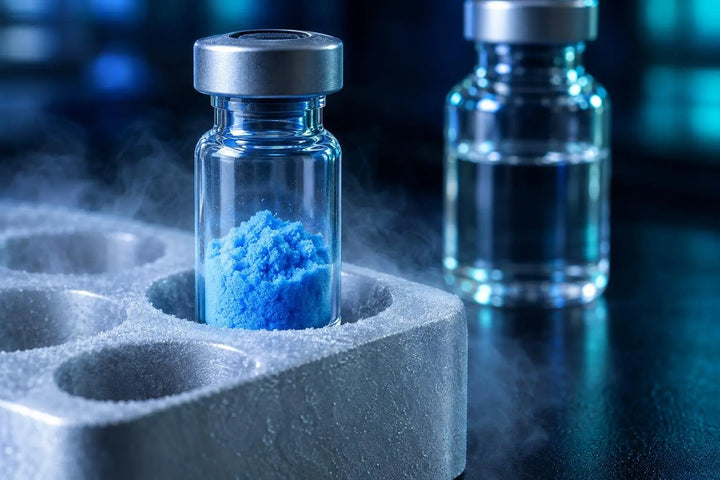
| Lyophilized appearance | Colorless to white | Blue, from the copper(II) d-d absorption |
| Copper content | None | About 15.8% by mass for the bare 1:1 cation |
How does copper(II) bind GHK, and what is present in solution?
GHK offers an N-terminal amine, backbone amides, a histidine imidazole, a lysine side-chain amine and a carboxylate, and copper(II) is reported to be held mainly by the amine, an amide nitrogen and the imidazole. The bonding detail is covered in GHK-Cu and copper coordination chemistry in vitro; this guide focuses on what that means for the material in your tube.
What species is actually present depends on several variables:
- pH: amide deprotonation, and therefore tight binding, needs near-neutral conditions.
- Copper-to-peptide ratio: with excess peptide a 2:1 species forms; PubChem lists it as bis-prezatide copper (C28H46CuN12O8, 742.3 g/mol, CID 9831891).
- Buffer and medium: phosphate, Tris, HEPES, free histidine and proteins in culture medium all compete for copper.
- Trace copper: free GHK added to a medium can pick up copper that is already there, so the species is not fully controlled.
The practical consequence: record pH, buffer and ratio, and do not assume the species added is the species measured.
Why is the copper complex the catalog form?
Supplying GHK as the complex starts every experiment from a defined, copper-loaded material with a built-in visual check, the blue color of the lyophilized powder. Free GHK leaves copper loading to chance. Many designs use both forms as a matched pair, with GHK without copper as a control, as discussed in the GHK-Cu research guide. Names such as GHK copper, Cu-GHK and Cu peptide normally mean the complex, whereas GHK on its own means the free peptide; the name-variants guide maps each label.
How is identity confirmed by mass spectrometry?
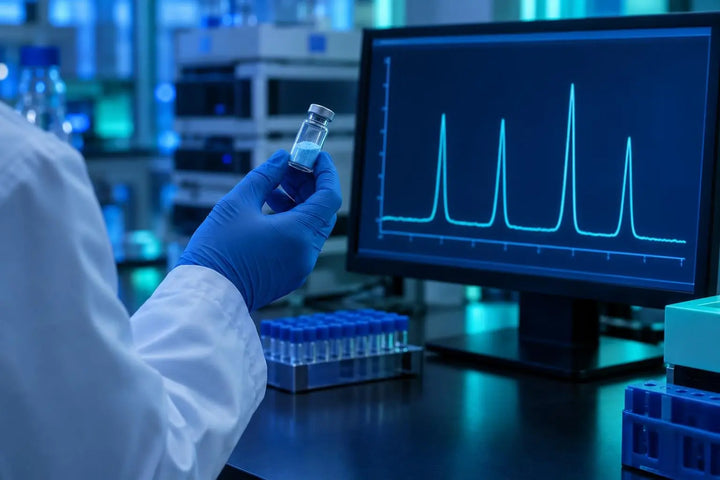
For the free peptide, the protonated ion [M+H]+ appears at m/z 341.19. For the complex, look for the copper isotope signature: 63Cu and 65Cu occur in roughly a 69:31 ratio, so the ion appears at m/z 402.11 with a partner near 404.11 at about 45% of its height. That doublet is a strong sign copper is present. One caution: acidic mobile phases and in-source conditions can strip copper, so a peak at 341.19 in a complex sample does not on its own prove the sample is free peptide. Pair mass spectrometry with a UV-Vis check or a copper-content measurement. The general method is described in mass spectrometry for peptide identity confirmation.
Related research guides
- AHK-Cu vs GHK-Cu: two copper-binding tripeptides compared
- Sourcing GHK-Cu as a research material: COA, copper content and purity
- HPLC for peptides: how purity is measured
Research-use note
All materials discussed are supplied for in vitro laboratory research use only, and are not for human or animal use.