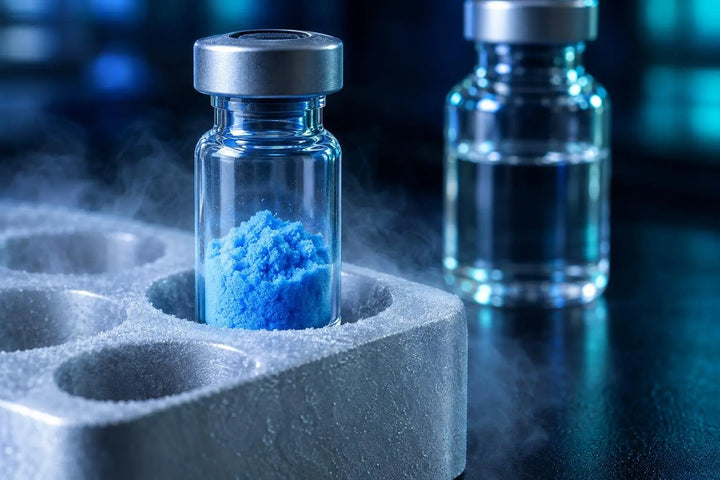
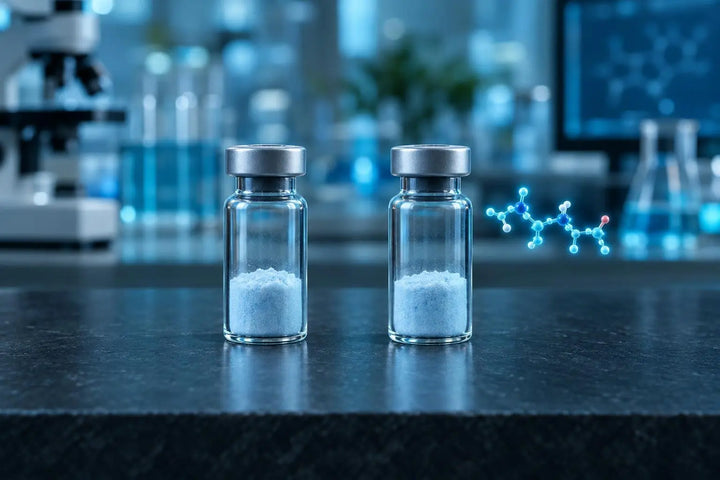
Lyophilized peptides are research peptides that have been freeze-dried: the water is removed by freezing and sublimation under vacuum, leaving a stable dry solid that ships and stores far better than a solution. This guide explains what lyophilized peptides are, how to judge the cake in the vial, and what that means for handling in the lab.
What are lyophilized peptides?
Lyophilization freezes a peptide solution and then removes the ice directly as vapor under vacuum (sublimation). The result is a dry, porous cake or powder with very little residual water. Most research peptides are supplied this way.
Why are peptides freeze-dried?
Water drives many of the reactions that degrade peptides, including hydrolysis, deamidation and oxidation. Removing it makes the material far more stable for shipping and storage, so the peptide arrives intact and ready to reconstitute.
What does the dry cake look like?
A lyophilized peptide often appears as a small white cake or a thin film at the bottom of the vial. A barely visible amount is normal for small masses, because a few milligrams of solid occupy very little space.
How can you tell a good lyophilized cake?
Appearance is only a rough screen, but a few features are worth noting when a vial arrives:
- Color: white to off-white is typical. Yellowing or browning can point to oxidation or contamination.
- Texture: a loose, porous cake or fine powder is expected. A shrunken, glassy or collapsed plug can happen with some sequences and is not proof of a problem on its own.
- Moisture: a sticky, wet-looking or clumped solid suggests water uptake, so the seal and storage history deserve a second look.
- Seal and vacuum: an intact stopper and crimp cap are the first line of protection for lyophilized peptides.
Appearance cannot confirm identity or purity. For that, rely on the batch Certificate of Analysis (HPLC purity and mass spectrometry), as covered in our guide to verifying research peptide purity.
How should lyophilized peptides be stored?
Lyophilized peptides are most stable cold, dry and dark. Long-term storage at -20 C or colder, away from light and humidity, is the common practice. Let a cold vial warm to room temperature before opening it, so condensation does not wet the cake, and keep the cap sealed between uses. Once the solid is dissolved, stability drops sharply, so a reconstituted stock is usually divided into single-use aliquots to avoid repeated freeze-thaw cycles.
What does it mean for handling?
Because the material is dry and stable, you store it cold and reconstitute it only when you are ready to run an assay, using an appropriate solvent such as a peptide-grade reconstitution solution. That turns the dry solid into a solution of known concentration.
Related research guides
- What are research peptides? A laboratory primer
- Peptide vs. protein vs. small molecule
- How peptides are synthesized (SPPS)
- Semaglutide stability: a handling guide for laboratory researchers
Research-use note
All peptides discussed are supplied for in vitro laboratory research use only, and are not for human or animal use.