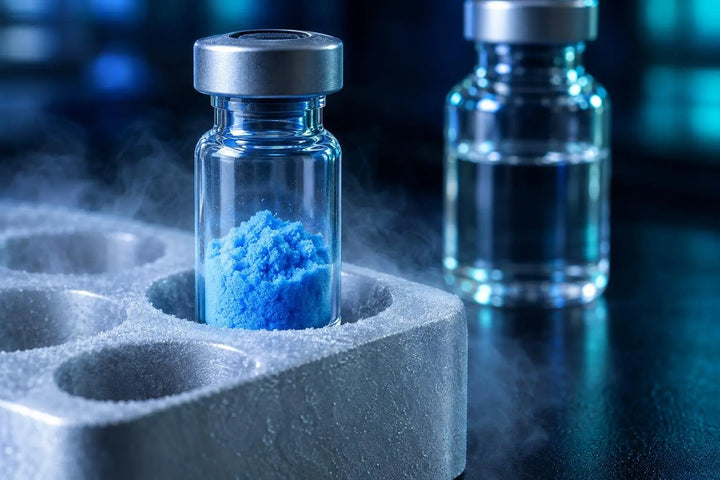
"SS31 peptides", "SS-31 peptide" and "elamipretide" all name the same compound: the synthetic aromatic-cationic tetrapeptide D-Arg-Dmt-Lys-Phe-NH2 (CAS 736992-21-5, C32H49N9O5, 639.8 g/mol), also carried in the literature under the development code MTP-131. This guide explains where each name comes from, lays out the identifiers a Certificate of Analysis should carry, and shows how a laboratory confirms that a vial labelled SS-31 contains that sequence.
Why is it called SS-31?
"SS" stands for Szeto-Schiller, the two researchers whose groups designed a series of small aromatic-cationic peptides; the number is the series position, so SS-31 is one member of a numbered set that also includes SS-02 and SS-20. The hyphen is a typographic convention rather than part of the chemical identity, which is why "SS31", "SS 31" and "SS-31" appear interchangeably in search queries and supplier listings. The plural "SS31 peptides" is simply the search-engine form of the same term; there is one compound, not several.
What do elamipretide and MTP-131 refer to?
Elamipretide is the International Nonproprietary Name assigned to the molecule, so it is the correct generic chemical name to use in a methods section. MTP-131 is an earlier development code for the same structure. Trade names also exist for the compound in other contexts, but a research-use listing should be identified by its INN, sequence and CAS number, never by a trade name. The SS-31 product page lists the compound under both SS-31 and elamipretide.
What are the identifiers for SS-31?
| Identifier | Value |
|---|---|
| Names | SS-31, SS31, elamipretide (INN), MTP-131 |
| Sequence | D-Arg-Dmt-Lys-Phe-NH2 (Dmt = 2',6'-dimethyltyrosine) |
| Length | 4 residues, C-terminal amide |
| CAS number | 736992-21-5 |
| Molecular formula | C32H49N9O5 |
| Molecular weight | 639.8 g/mol |
| PubChem | CID 11764719 (as listed on the product page) |
| Vial sizes listed | 10 mg and 50 mg lyophilized powder |
Two features make the sequence unusual and worth checking on a COA. The first residue is D-arginine rather than the natural L-form, and the second is dimethyltyrosine, a non-coded amino acid. Both are deliberate design choices in the aromatic-cationic motif; a peptide with the same four-letter abbreviation but built entirely from L-amino acids and plain tyrosine would be a different compound with a different mass. The structure and its association with the inner mitochondrial membrane are covered in the researcher's guide to SS-31 (elamipretide).
How do you confirm an SS31 vial is actually elamipretide?
- Mass spectrometry. The expected [M+H]+ is about 640.4. Plain tyrosine in place of Dmt would read about 28 units lower, so the measured mass directly confirms the non-coded residue.
- HPLC purity. One dominant peak, reported as a percentage of area; the catalog specification is approximately 99%.
- Chirality note. Standard mass spectrometry does not distinguish D-arginine from L-arginine. If the D-configuration matters to your assay, ask the supplier for chiral-amino-acid analysis or a synthesis record. The SS-31 sourcing guide covers what to request on the COA.
Stock concentration math for the 10 mg and 50 mg vials
At 639.8 g/mol, 10 mg in 1 mL of reconstitution solution is 10 mg/mL, or 15.6 mM; in 2 mL it is 7.8 mM. The 50 mg vial in 5 mL gives the same 15.6 mM stock. Because SS-31 is small, equal mg/mL is a much higher molarity than for longer peptides; the MOTS-c vs SS-31 comparison works through that difference.
Related research guides
- A researcher's guide to SS-31 (elamipretide)
- Sourcing SS-31 as a research material: COA and purity
- SS-31 and the inner mitochondrial membrane (cardiolipin)
- MOTS-c vs SS-31 compared
- Mass spectrometry for peptide identity confirmation
Research-use note
All materials discussed are supplied for in vitro laboratory research use only, and are not for human or animal use.